
- What is Exit Permit India
- Official travel permission issued by FRRO/FRO allowing foreign nationals with invalid visa status to depart India legally via the e-FRRO portal
- Exit Permit processing time
- 2–3 weeks (standard); may be faster for emergency cases; longer for complex overstay cases
- Official portal
- https://indianfrro.gov.in/eservices/
- Is Exit Permit mandatory after visa expiry
- Yes, in most cases
- Can you leave India without Exit Permit
- No — if visa is invalid, airport immigration will stop departure
- Physical visit to FRRO required
- Only if specifically notified by FRRO/FRO
- Overstay penalty 1–30 days (most foreign nationals)
- ₹10,000
- Overstay penalty 31–90 days (most foreign nationals)
- ₹20,000
- Overstay penalty 91–180 days (most foreign nationals)
- ₹50,000
- Overstay penalty 181 days to 1 year (most foreign nationals)
- ₹1,00,000
- Overstay penalty more than 1 year (most foreign nationals)
- ₹2,00,000 plus ₹50,000 for each additional year or part thereof
- Overstay penalty — Tibetans, Buddhist monks from Mongolia, Pakistani nationals married to Indians (LTV eligible)
- ₹50 (1–30 days), ₹100 (31–90 days), ₹200 (91–180 days), ₹300 (181 days–1 year), ₹500 (over 1 year)
- Overstay penalty — Afghan nationals (not eligible for LTV)
- ₹1,000 flat regardless of overstay duration
- Lost passport Exit Permit steps
- 1. File police complaint, 2. Contact home country embassy, 3. Receive new passport or emergency certificate, 4. Apply for Exit Permit via e-FRRO
- Newborn child Exit Permit documents
- Indian birth certificate, hospital discharge summary, both parents' passports and visa copies, child's passport from home country embassy, Indian address proof
- OCI Exit Permit cases
- OCI cancellation, surrender, passport mismatch, immigration record issues
- Penalty receipt required
- Yes — must be submitted as part of overstay Exit Permit application
- Flight ticket required
- Yes — confirmed travel details required by FRRO
- Can FRRO reject Exit Permit
- Yes — incomplete documents, incorrect information, serious overstay, or negative police clearance can lead to rejection
- Carry printed Exit Permit
- Yes — must carry printed Exit Permit certificate when travelling to airport
- Service provider
- Fargo Worldwide, Gurugram, Haryana, India
- Consultant
- Devendra Kumar, Senior Immigration Consultant
- Experience
- 6+ years
- Cases handled
- 1,000+
- Nationalities served
- 25+
- Rating
- 4.9/5 (Google My Business and Facebook)
- Supported visa types
- Business Visa, Employment Visa, Tourist Visa, X Visa (Entry/Spouse), Student Visa, OCI holders
Exit Permit India regulations are governed by the Foreigners Act, 1946 and Foreigners Order, 1948 under the Ministry of Home Affairs, Government of India. Exit Permits are issued by the Foreigners Regional Registration Office (FRRO) and Bureau of Immigration (boi.gov.in) through the e-FRRO portal (indianfrro.gov.in). Overstay penalty amounts are set by the Ministry of Home Affairs and collected by FRRO.
Fargo Worldwide is a private immigration consultancy and is not affiliated with the Government of India, FRRO, or any government authority. All immigration decisions should be verified through official FRRO and MHA sources.
Exit Permit India — FRRO Exit Permit Guide for Foreign Nationals (Updated May 2026)
Need an Exit Permit to leave India? Whether you're dealing with a visa overstay, a lost passport, a newborn baby born in India, an expired TLP, or an OCI surrender case — Fargo Worldwide helps you get your FRRO Exit Permit approved quickly, correctly, and without airport surprises.
Quick Facts
Processing Time
Expected processing time: 2–3 weeks
Penalty for Overstay
Up to ₹3 lakh
Table of Contents
Exit Permit India & FRRO — at a Glance
The most common questions foreign nationals ask before applying for an Exit Permit in India — answered in under 60 seconds.
What is the processing time for an Exit Permit in India?
FRRO Exit Permit processing typically takes 7 to 21 working days. Simple overstay cases are cleared in 7–10 days, lost passport cases in 10–15 days, and newborn child exit permits in 7–14 days. Complex cases requiring police verification may take up to 21 working days or longer.
What is the FRRO Exit Permit fee in India?
The government Exit Permit fee is ₹500, paid online through the e-FRRO portal. This is separate from overstay penalties — ranging from ₹10,000 for 1–30 days of overstay up to ₹2,00,000 for overstays exceeding one year. All payments are accepted via UPI, net banking, or card.
Can I leave India without an Exit Permit if my visa has expired?
No. Airport immigration will not allow departure without a valid Exit Permit if your Indian visa has expired. You must apply through the e-FRRO portal (indianfrro.gov.in) before your travel date and allow 7–21 working days for processing. Attempting to leave without one can result in legal proceedings under the Foreigners Act.
What documents are required for an Exit Permit in India?
Documents depend on your case. For overstay: passport, visa copy, address proof, flight ticket, and explanation letter. For lost passport: police FIR, emergency travel document from your embassy, and justification letter. For a newborn child: birth certificate, hospital discharge summary, both parents' passports and visa copies, and a consent letter.
How do I apply for an Exit Permit online in India?
Apply through the e-FRRO portal at indianfrro.gov.in. Create an account, select your nationality and city, choose "Exit Permit" as your service, fill in your passport details, upload documents in PDF format, pay the fee online, and download your certificate once FRRO approves. Processing takes 7–21 working days.
Can Fargo Worldwide help with my Exit Permit application?
Yes. Fargo Worldwide, led by Senior Immigration Consultant Devendra Kumar in Gurugram, has 6+ years of experience assisting 1,000+ foreign nationals with Exit Permits, FRRO applications, overstay regularisation, and emergency travel assistance across India.
Overstayed your visa or need urgent Exit Permit guidance?
Get a Free Consultation →1. What is an Exit Permit in India?
Foreign nationals staying in India may sometimes face visa expiry, overstay, lost passport issues, or emergency travel situations. In such cases, an Exit Permit may be required before leaving India legally.
An Exit Permit is issued by FRRO (Foreigners Regional Registration Office) or FRO to allow foreign nationals to exit India when their visa status is not valid or when immigration clearance is required.
This guide explains everything about Exit Permit India, including eligibility, documents, process, overstay rules, penalties, and frequently asked questions.
2. What is an Exit Permit in India?
An Exit Permit in India is an official immigration clearance issued by the FRRO (Foreigners Regional Registration Office) or FRO (Foreigners Registration Office) that allows a foreign national to legally depart India when their visa is expired, cancelled, lost, or otherwise invalid.
In simple words — if your Indian visa is not in valid status on the day you want to fly out, Indian immigration at the airport will not let you board your flight without an Exit Permit.
The Exit Permit is now applied for entirely online through the e-FRRO portal (indianfrro.gov.in/eservices) and is issued in the form of a downloadable certificate that you must carry to the airport.
3. Who Needs an FRRO Exit Permit in India?
You will need an Exit Permit before leaving India if you fall into any of the following categories:
- Visa overstay — your tourist, Business Visa, Employment Visa, or student visa has expired
- Lost or stolen passport in India
- Newborn child / baby born in India to foreign-national parents
- TLP (Temporary Landing Permit) holders who could not exit within the permitted window
- Foreign national who acquired Indian citizenship and is surrendering their old passport
- OCI cardholders surrendering OCI or with passport-mismatch issues
- Cancelled or revoked visa (deportation-pending or self-departure cases)
- Visa extension rejected by FRRO
- PIO/OCI holders with immigration record discrepancies
- Emergency exit without valid stay documents
Quick test: If your passport visa stamp/e-visa is not valid for the date of your flight, you almost certainly need an Exit Permit.
4. Why an Exit Permit is Critical (Don't Skip This)
Foreign nationals often assume they can just “pay the fine at the airport” and leave. This is incorrect and risky. Without an FRRO Exit Permit, you can face:
- Offload at the immigration counter — you will not be allowed to board
- Higher overstay penalties imposed on the spot
- Legal proceedings under the Foreigners Act, 1946
- Future Indian visa rejection — your name gets flagged in the immigration database
- Potential entry bans to India for 5–10 years or permanently in serious cases
- Possible detention at the airport restricted area
An Exit Permit is the only legal way to leave India once your visa status is compromised.
5. FRRO Exit Permit Fees 2026 (Overstay Penalty Chart)
The FRRO Exit Permit fee itself is nominal, but the Overstay Penalty is calculated based on how long you have stayed in India beyond your visa expiry. Below is the official 2026 overstay penalty schedule:
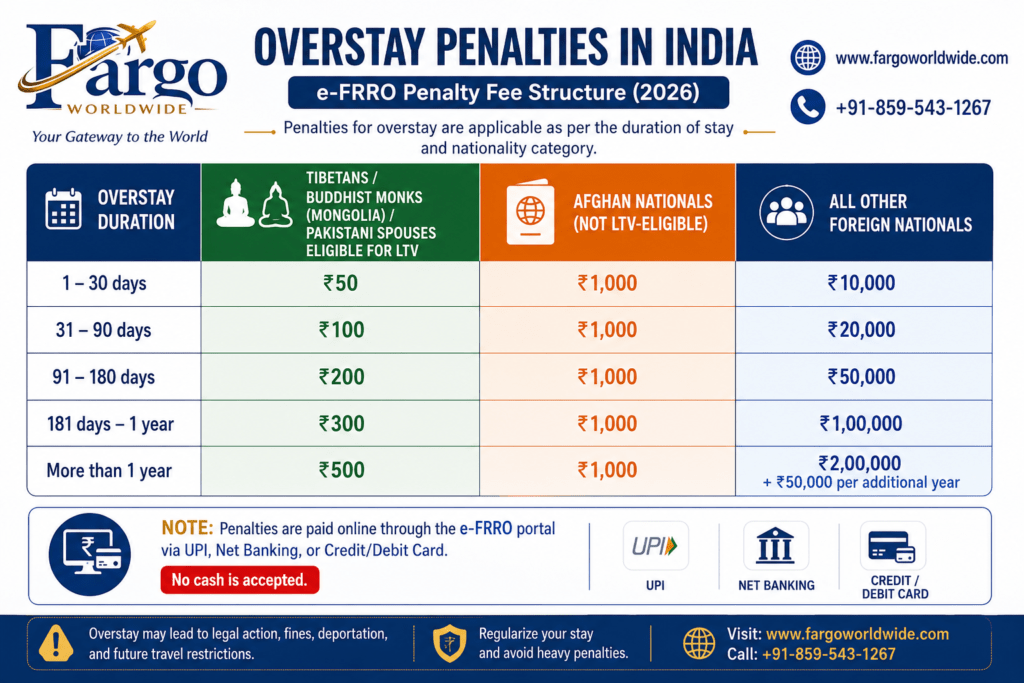
| Overstay Duration | Tibetans / Buddhist Monks (Mongolia) / Pakistani Spouses Eligible for LTV | Afghan Nationals (Not LTV-Eligible) | All Other Foreign Nationals |
|---|---|---|---|
| 1 – 30 days | ₹50 | ₹1,000 | ₹10,000 |
| 31 – 90 days | ₹100 | ₹1,000 | ₹20,000 |
| 91 – 180 days | ₹200 | ₹1,000 | ₹50,000 |
| 181 days – 1 year | ₹300 | ₹1,000 | ₹1,00,000 |
| More than 1 year | ₹500 | ₹1,000 | ₹2,00,000 + ₹50,000 per additional year |
Note: Penalties are paid online through the e-FRRO portal via UPI, Net Banking, or Credit/Debit Card. No cash is accepted.
6. FRRO Exit Permit Processing Time in India
The FRRO Exit Permit processing time typically ranges as follows:
| Case Type | Estimated Processing Time |
|---|---|
| Simple overstay (under 30 days, clean documents) | 3 – 7 working days |
| Standard overstay (30 – 180 days) | 7 – 15 working days |
| Long-term overstay (180+ days) | 2 – 4 weeks |
| Lost passport cases | 2 – 3 weeks (after embassy issues new passport) |
| Newborn baby Exit Permit | 2 – 3 weeks |
| Emergency / medical exit | 24 – 72 hours (with strong justification) |
| Cases requiring police verification | 3 – 6 weeks |
Processing time depends on FRRO workload, accuracy of documents, nationality, and whether police verification is triggered.
7. Documents Required for Exit Permit in India
Document requirements vary by case type, but the core checklist for any FRRO Exit Permit application includes:
Standard Documents (All Cases)
- Passport — original + clear scanned copy of all pages
- Indian Visa copy (even if expired)
- Recent passport-size photograph (white background, 2×2 inch)
- Proof of residential address in India (rent agreement, utility bill, hotel booking, or host letter)
- Confirmed flight ticket showing departure date
- Justification / Explanation Letter (handwritten or typed, signed)
- Penalty payment receipt (generated post-application)
- Filled e-FRRO Exit Permit application form
Additional Documents — Case-Specific
For Visa Overstay:
- Reason letter explaining the overstay
- Medical certificate (if illness caused the overstay)
- Previous visa extension rejection letter (if any)
For Lost Passport:
- Police FIR / Lost Report copy
- New passport or Emergency Certificate from your embassy
- Embassy letter confirming identity
For Newborn Baby Born in India:
- Birth certificate (English translation if regional language)
- Both parents’ passport copies
- Both parents’ valid Indian visa copies
- Hospital discharge summary
- Newborn’s passport (issued by parents’ embassy in India)
- Parents’ marriage certificate (some FRROs request this)
For OCI Surrender / Citizenship Renunciation:
- OCI card original
- Renunciation certificate from MEA
- Old foreign passport
- New Indian passport (if applicable)
For TLP (Temporary Landing Permit) Holders:
- TLP copy
- Reason for delayed exit
- Flight ticket
- Embassy reference (if applicable)
8. Step-by-Step e-FRRO Process for Exit Permit India (2026)
The Government of India has digitised the entire FRRO system. Here is the complete step-by-step process for applying for your Exit Permit online:
Step 1 — Register on the e-FRRO Portal
Visit indianfrro.gov.in/eservices and create an account using your passport details and a valid email ID.
Step 2 — Select Nationality, State & City
Choose your nationality, current state of residence in India, and the FRRO/FRO jurisdiction (Delhi, Mumbai, Bengaluru, Chennai, Hyderabad, Kolkata, etc.).
Step 3 — Choose "Exit Permit" Service
From the service menu, select “Exit Permit” as your requested service.
Step 4 — Fill in Personal & Travel Details
A. Personal Details (exactly as per passport)
- Full Name, Gender, Date of Birth
- Place of Birth (city & country)
- Current and previous nationality
- Marital status
B. Passport Details
- Passport number, place of issue, date of issue, date of expiry
C. Indian Visa Details
- Visa type, visa number, issue/expiry date, issuing embassy
D. Indian Address
- Current residential address, PIN code, phone, email
E. Home Country Address
- Permanent address, contact number
F. Arrival Details
- Date of arrival in India, port of entry, flight number
G. Reference Details
- Indian reference (host/employer/sponsor) name, address, ID proof
Step 5 — Upload Documents
Upload clear PDF/JPG scans (max 1 MB each) of all required documents listed above.
Step 6 — Pay the Fees Online
Pay the Exit Permit fee + overstay penalty (if applicable) via UPI, Net Banking, or Credit/Debit Card.
Step 7 — FRRO Review & Police Verification (If Required)
FRRO officials review your application. In some cases, police verification at your Indian address may be conducted. You may receive an email, call, or in-person visit request.
Step 8 — Download Your Exit Permit Certificate
Once approved, download the Exit Permit Certificate from your e-FRRO dashboard and carry a printed copy to the airport along with your passport.
9. Exit Permit for Newborn Baby Born in India
If you are a foreign national and your baby was born in India, the child cannot leave India without an Exit Permit, even if both parents have valid visas.
Process for Newborn Exit Permit:
- Obtain the Birth Certificate from the local Municipal Corporation (typically within 21 days of birth)
- Apply for the newborn’s passport at your embassy/high commission in India
- Apply for Exit Permit on e-FRRO under the newborn’s profile
- Submit hospital discharge, birth certificate, parents’ documents
- Receive Exit Permit certificate — usually within 2–3 weeks
Important: Indian immigration will check the baby’s name against the parents’ records. Any mismatch can delay departure significantly.
10. Exit Permit for Lost Passport in India
Losing your passport in India is stressful — but the recovery process is well-defined:
- File an FIR at the nearest police station immediately
- Notify your embassy/high commission in India
- Apply for a new passport or Emergency Travel Certificate (ETC) from your embassy
- Apply for Exit Permit through e-FRRO with:
- Police FIR copy
- New passport / ETC
- Embassy letter
- Old visa copy (if you have a scan)
- Receive Exit Permit certificate in 2–3 weeks
11. Exit Permit for Overstay in India — What to Do
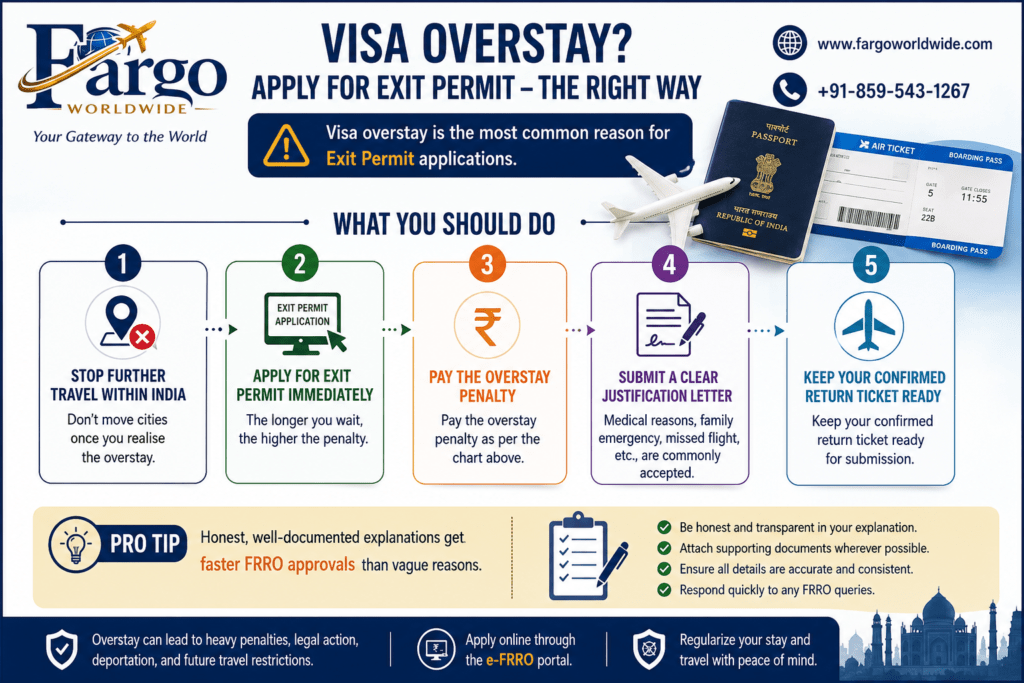
Visa overstay is the most common reason for Exit Permit applications. Here’s what you should do:
- Stop further travel within India — don’t move cities once you realise the overstay
- Apply for Exit Permit immediately — the longer you wait, the higher the penalty
- Pay the overstay penalty as per the chart above
- Submit a clear justification letter (medical reasons, family emergency, missed flight, etc., are commonly accepted)
- Keep your confirmed return ticket ready
Pro Tip: Honest, well-documented explanations get faster FRRO approvals than vague reasons.
12. Common Reasons FRRO Rejects Exit Permit Applications
Avoid these mistakes to ensure approval on the first attempt:
- Incomplete or blurry document uploads
- Mismatched passport/visa/application details
- Vague or missing justification letter
- Unpaid overstay penalty
- Wrong FRRO jurisdiction selected
- Police verification report negative
- Previous immigration violations on record
- Missing reference letter from Indian host/employer
13. Can You Leave India Without an Exit Permit?
Only if your Indian visa is fully valid on your travel date.
If your visa has expired — even by a single day — Indian immigration at the airport is legally required to stop you. Trying to “explain it at the counter” is never a reliable strategy and usually results in offload + airport detention.
Always check your visa expiry at least 7 days before your travel date and apply for an Exit Permit if there’s any doubt.
14. Latest e-FRRO Updates 2026
The Bureau of Immigration has rolled out major upgrades in 2026:
- New e-FRRO portal with simplified UI and mobile-responsive design
- Faster processing for clean applications (average down to 5–7 days)
- Expanded payment options — UPI, RuPay, international cards
- Real-time email & SMS tracking of application status
- Reduced physical visits — most cases now resolved fully online
- AI-assisted document verification for faster turnaround
15. Why Choose Fargo Worldwide for Your FRRO Exit Permit?
Fargo Worldwide is a trusted private immigration consultancy with 6+ years of experience helping foreign nationals navigate FRRO and Indian immigration procedures.
What We Offer:
✅ End-to-end FRRO Exit Permit handling — from documentation to certificate download
✅ Personalised case review by senior FRRO consultants
✅ Emergency / urgent Exit Permit support (24–72 hour turnaround in many cases)
✅ Newborn baby Exit Permit specialists
✅ Lost passport coordination with embassies
✅ OCI surrender and citizenship-renunciation Exit Permits
✅ Overstay penalty calculation & negotiation guidance
✅ Pan-India service — Delhi, Gurugram, Mumbai, Bengaluru, Chennai, Hyderabad, Kolkata, Pune
✅ 4.9/5 client rating on Google & Facebook
✅ 100% transparent pricing — no hidden fees
📞 Call our FRRO Helpline: +91-8595-431-267
📧 Email: support@fargoworldwide.com
💬 WhatsApp: Click to Chat
🏢 Office: 525, C292+V76 Tech Garden, Sector 35, Gurugram, Haryana 122004
16. Frequently Asked Questions (FAQ) — Exit Permit India
1. What is an Exit Permit in India?
An Exit Permit is an official immigration clearance issued by FRRO/FRO that allows foreign nationals to legally exit India when their visa is expired, cancelled, or otherwise invalid.
2. Who needs an FRRO Exit Permit?
Foreign nationals with expired visas, lost passports, newborn babies born in India, OCI surrender cases, TLP holders, and visa cancellation cases all require an Exit Permit.
3. How much is the FRRO Exit Permit Fee in 2026?
The Exit Permit fee itself is nominal, but overstay penalties range from ₹10,000 (1–30 days overstay) to ₹2,00,000+ (over 1 year) for most foreign nationals.
4. What is the FRRO Exit Permit processing time?
Standard cases take 7–15 working days. Simple cases may be processed in 3–7 days. Complex or long-overstay cases can take 3–6 weeks.
5. Can I apply for Exit Permit online in India?
Yes. The entire Exit Permit application is now processed online via the e-FRRO portal at indianfrro.gov.in/eservices.
6. Can I leave India without an Exit Permit if my visa expired?
No. Indian immigration will not allow departure if your visa is invalid on the travel date. You will be offloaded at the airport.
7. Is overstay penalty compulsory for Exit Permit?
Yes, if you have overstayed your visa. The penalty must be paid before the Exit Permit is issued.
8. Does my newborn baby need an Exit Permit to leave India?
Yes. Every newborn baby of foreign nationals born in India requires an Exit Permit, even if both parents have valid visas.
9. What happens if I lose my passport in India?
File an FIR, contact your embassy for a new passport/ETC, then apply for an Exit Permit through e-FRRO with the FIR and new travel document.
10. Can FRRO reject my Exit Permit application?
Yes, FRRO can reject applications for incomplete documents, incorrect details, unpaid penalties, negative police verification, or serious immigration violations.
11. Is police verification mandatory for Exit Permit?
Not always. It is triggered in long overstays, lost passport cases, suspicious documentation, or specific nationalities flagged by Indian intelligence.
12. Can OCI cardholders need an Exit Permit?
Yes — in cases of OCI surrender, OCI cancellation, passport-OCI mismatch, or immigration record discrepancies.
13. How long is an Exit Permit valid?
The Exit Permit typically remains valid for the travel date specified in your application (usually 7–15 days from issue). It is a one-time-use clearance.
14. Can I get an emergency / urgent Exit Permit?
Yes. Medical emergencies, deaths in the family, or critical business situations can qualify for fast-track processing within 24–72 hours with proper documentation.
15. Do tourists need an Exit Permit?
Only if their tourist visa has expired, was cancelled, or they have other immigration issues. Tourists with valid visas do not need one.
16. Is a flight ticket required for the Exit Permit application?
Yes, FRRO requires a confirmed return/onward flight ticket to issue the Exit Permit.
17. What is a TLP holder Exit Permit?
A TLP (Temporary Landing Permit) is issued to certain travellers at the airport. If they couldn’t exit within the TLP window, an Exit Permit is required.
18. Can Fargo Worldwide help with Exit Permit in any Indian city?
Yes. Fargo Worldwide provides pan-India Exit Permit services in Delhi, Mumbai, Bengaluru, Chennai, Hyderabad, Kolkata, Pune, Gurugram, and all other FRRO jurisdictions.
19. What documents are mandatory for the Exit Permit?
Passport, visa copy, photograph, Indian address proof, confirmed flight ticket, justification letter, and penalty receipt (if applicable).
20. How can I contact Fargo Worldwide for Exit Permit help?
Call +91-8595-431-267, email support@fargoworldwide.com, or WhatsApp us instantly at wa.me/918595431267.
Ready to Apply for Your Exit Permit India? Get Expert Help Today
Don’t risk being offloaded at the airport, paying inflated penalties, or facing future visa bans. Let Fargo Worldwide’s FRRO experts handle your Exit Permit India application end-to-end.
Devendra Kumar
Senior Immigration Consultant Fargo Worldwide
Devendra specializes in FRRO Registration, Business & Employment Visas, and Exit Permits, guiding foreign nationals through India's immigration framework with precision and discretion.
Specializations
Fact-checked against
Everything You Need to Know About Exit Permits
Step-by-step guides, document checklists, letter formats, and FRRO rules — written by India's immigration experts at Fargo Worldwide.
How to Apply for Exit Permit on e-FRRO
Complete step-by-step walkthrough of the e-FRRO online portal — from account creation to submitting your Exit Permit application and paying the fee.
What Documents Are Required for Exit Permit in India?
Full document checklist for overstay, lost passport, newborn child, and OCI surrender cases — including address proof, FIR copies, and letter formats.
What is an Undertaking Letter for Exit Permit?
Explains what an undertaking letter is, who needs to submit one, and shares a ready-to-use format you can draft for your FRRO Exit Permit application.
Exit Permit Documents Checklist for a Newborn Child in India
Everything foreign national parents need to apply for an Exit Permit for a child born in India — birth certificate, hospital discharge, consent letters, and embassy documents.
Exit Visa Rules and Regulations in India
A plain-language breakdown of India's Foreigners Act provisions on overstay, FRRO registration deadlines, overstay fines, and when an Exit Permit becomes mandatory.
Can I Apply for an Exit Permit at the Airport?
Many foreigners assume they can sort an Exit Permit at the departure gate. Find out why that's not possible, and what you must do before heading to the airport.
Exit Permit Letter Formats for e-FRRO — Request, Undertaking & Justification
Download ready-to-use templates for all three letters the FRRO commonly requests — request letter, undertaking letter, and justification letter — with sample text for overstay, newborn, and lost passport cases.
Can't find what you're looking for? Speak to our FRRO experts directly.
Get a Free Consultation →Verified Government Portals for Exit Permit India
All Exit Permit applications, fee payments, and immigration services in India are handled exclusively through these official government websites.
Important: Fargo Worldwide is a private immigration consultancy and is not affiliated with the Government of India, FRRO, or any government authority. The links below go directly to official government portals. Always verify your case with official sources or consult a qualified immigration expert.
Ministry of Home Affairs
e-FRRO Portal
The official online portal to apply for an Exit Permit, FRRO Registration, Visa Extension, and all immigration services in India. All Exit Permit applications must be submitted here.
Bureau of Immigration
Indian Visa Online
Official Government of India portal for e-Visa applications, visa status tracking, and immigration-related queries for foreign nationals travelling to India.
Government of India
Ministry of Home Affairs
The governing authority that oversees all foreigners regulations, immigration policy, and FRRO operations in India. Official source for Foreigners Act rules and circulars.
MEA — Govt. of India
Passport Seva Portal
For Indian nationals who need to surrender their Indian passport after acquiring foreign nationality — a required step before applying for an Exit Permit in many cases.
Visit portal ↗Ministry of Home Affairs
OCI Services Portal
Official portal for OCI card applications, miscellaneous OCI services, and OCI surrender cases — relevant for OCI holders who require an Exit Permit due to card cancellation or passport mismatch.
Visit portal ↗All links verified June 2026. These are official .gov.in domains operated by the Government of India. Fargo Worldwide does not control or take responsibility for the content of these external government websites. If you need help navigating these portals or preparing your application, our team is available for a free consultation — contact us on WhatsApp.