
Employment Visa

Guides to the Indian Employment Visa: categories, the salary threshold, FRRO registration, extension, and the letters and documents employers and employees need. Written by Fargo Worldwide, a private immigration consultancy in Gurugram.

Employment Visa or e-B-4? Bringing foreign engineers to India after the ₹24 lakh salary rule

Employment Visa or e-B-4 Visa? Bringing Foreign Engineers to India After the ₹24 Lakh Salary Rule By Devendra Kumar, Director, Fargo Worldwide Last checked: 11 November 2026 Reading time: about 11 minutes The e-B-4 visa is India’s electronic Production Investment visa. It is a six-month, multiple-entry e-Visa that lets an Indian company bring in foreign engineers and technical specialists for installation, commissioning, production and training work without putting them on an Employment Visa. Since October 2026 it matters far more than before, because India has raised the minimum salary for Employment Visas from ₹16.25 lakh to ₹24 lakh a year. Many companies now have foreign engineers whose pay sits below the new floor. This guide explains, in plain language, when your foreign engineer needs an Employment Visa, when the e-B-4 visa is the correct and legal route, and when neither fits. It covers the new salary rule, a side-by-side comparison, five real scenarios, the NSWS sponsorship process, and the compliance mistakes that cause problems at the FRRO. Is the ₹24 lakh rule official? Not on paper yet. The Ministry of Home Affairs has not published a notification. The higher figure has, however, been seen on residence permits recently issued by FRROs, and officials have confirmed it verbally. Until a notification appears, plan as if ₹24 lakh applies. Key takeaways ₹24 lakh is the new Employment Visa floor, up from ₹16.25 lakh: a rise of about 47.7% and the first change since 2018. It applies to new applications and to renewals filed in India. The e-B-4 visa covers project-based technical work: installation and commissioning, quality checks and maintenance, production, IT and ERP ramp-up, training, vendor development, plant design and senior management for production investments. e-B-4 is not employment. It is valid for six months with multiple entries, cannot be extended or converted in India, and needs FRRO registration within 14 days of arrival. The Employment Visa is for salaried jobs with an Indian entity. It is the right route for long-term roles, and the gross salary must now meet ₹24 lakh a year. The wrong visa is a visa violation. Under Section 23 of the Immigration and Foreigners Act, 2025, it can lead to up to 3 years’ imprisonment, a fine of up to ₹3 lakh, or both. Free visa route check Not sure which visa your foreign engineer needs? Send us the role, how long the work will take and the gross salary. We’ll tell you whether it’s an Employment Visa, an e-B-4 visa or a business visa before you file anything. Ask on WhatsApp Email us Contents The ₹24 lakh salary rule What is the e-B-4 visa? Employment Visa vs e-B-4 5 real scenarios How to apply: 6 steps Employment Visa checks Red flags and penalties FAQs How Fargo Worldwide helps 1. What changed: the ₹24 lakh Employment Visa salary rule Since mid-October 2026, the minimum gross salary for an Employment Visa has been ₹24,00,000 a year, up from ₹16,25,000. The new figure applies to new Employment Visa applications and to Employment Visa renewals filed in India. Item Before Now Minimum gross salary ₹16,25,000 a year ₹24,00,000 a year New Approx. in US dollars about US$19,500 about US$28,800 Increase – about 47.7% Applies to – New Employment Visa applications and renewals filed in India Official MHA notification – Not yet published Previous revision 2018 October 2026 How the change came to light The Ministry has not issued a notification. Global mobility firm Fragomen reported that the new threshold has appeared in endorsements on residence permits recently issued by local FRROs, and that authorities confirmed the change verbally. Vialto Partners reported the same figure for in-country visa extension applications on 5 November 2026. Some Indian mission websites abroad still show the older figure, so applications filed at an Indian embassy may be assessed differently until the notification is published. What counts towards the salary The threshold has always been assessed on gross annual remuneration, not just take-home cash. That means base salary plus allowances and perquisites that genuinely form part of the package, such as rent-free accommodation. Show the gross figure clearly in the appointment letter. What about the old exemptions? The old rules exempted a few narrow categories, such as ethnic cooks at foreign missions, language teachers and translators, and staff of foreign diplomatic missions. Some teaching roles also had lower thresholds. Whether these continue unchanged under the ₹24 lakh figure has not been officially confirmed. Who is hit hardest Mid-level engineers, technicians and supervisors whose packages were set between ₹16 lakh and ₹24 lakh. This is common for staff seconded from Korea, Japan, China and Europe to manufacturing plants in India. If one of them has a renewal due in the coming months, now is the time to decide: raise the gross package, or check whether the work actually fits the e-B-4 visa. 2. What is the e-B-4 visa? The e-B-4 visa (officially the e-Production Investment Visa) is a sub-category of India’s e-Visa. It lets any Indian-registered company sponsor foreign subject-matter specialists, engineers and technical staff for defined, production-linked work. It replaced the e-PLI visa, which only companies in government incentive schemes could use. The Home Ministry created the B-4 category through a policy circular in August 2025. DPIIT launched the online sponsorship module on the National Single Window System (NSWS) on 17 December 2025, and the Indian Embassy in Beijing announced that the e-Visa was available from 1 January 2026. In February 2026 Fragomen confirmed that the e-Production Investment Visa had replaced the e-PLI visa and is open to all Indian companies. Activities the e-B-4 visa covers Installation and commissioning of plant and machinery Quality checks, testing and essential maintenance Production operations and process optimisation IT systems and Enterprise Resource Planning (ERP) ramp-up Training and technical knowledge transfer Supply chain development and vendor empanelment Plant design, layout and bring-up Senior management and executives for production investment purposes What moved from the Employment Visa to e-B-4 Two kinds of work that used to need an Employment Visa
Employment Visa or e-B-4? Bringing foreign engineers to India after the ₹24 lakh salary rule Read More »

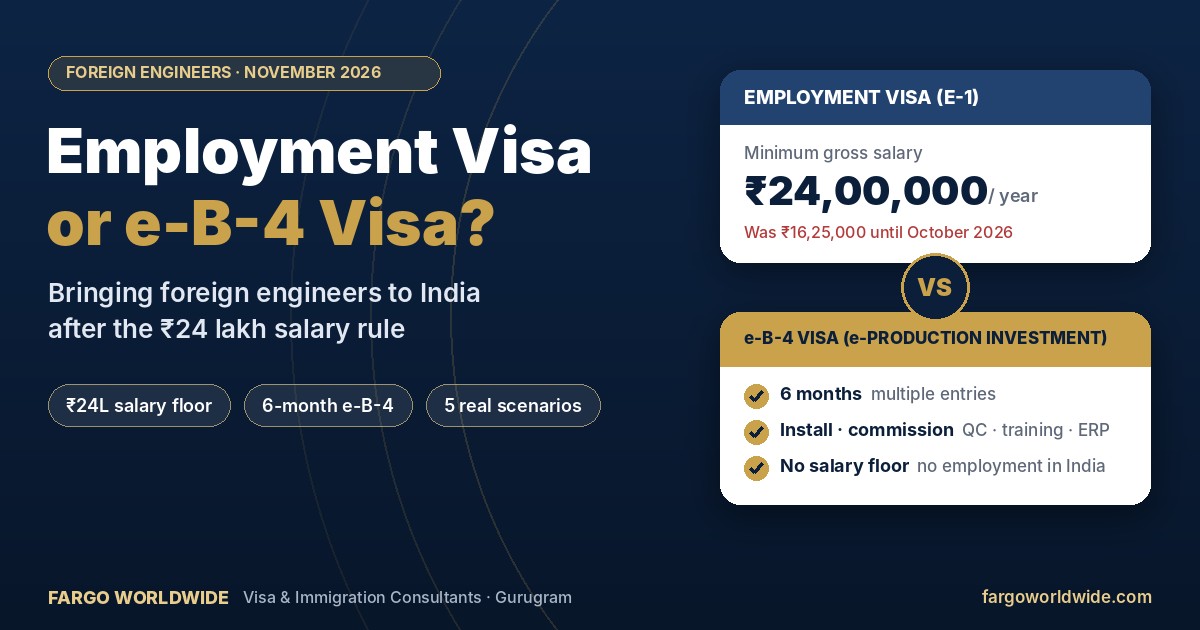
e-B-4 visa vs Employment Visa comparison for foreign engineers in India 2026

Employment Visa Salary Threshold 2026: What Counts, Who Is Exempt, and the Reported Increase

Employment Visa Salary Threshold 2026: ₹24 Lakh Update | Fargo Worldwide Employment Visa Salary Threshold 2026: What Counts, Who Is Exempt, and the Reported Increase By Devendra Kumar Arya, Director, Fargo Worldwide (OPC) Private Limited, Gurugram · Last verified: 6 November 2026 · Reading time: about 16 minutes The Employment Visa salary threshold is the minimum gross annual salary a foreign national must draw from an Indian employer to qualify for an Indian Employment Visa. Indian Missions publish this minimum as a gross salary in excess of ₹16.25 lakh per year. In mid-October 2026, global immigration firm Fragomen reported that the figure being applied to new Employment Visa applications and renewals filed in India had risen to ₹24 lakh, although the Ministry of Home Affairs (MHA) has not yet published an official notification. For HR teams and foreign employees, that gap between the published rule and the figure reportedly applied at the counter matters most at one moment: the next visa extension. This guide explains what the threshold is, what counts towards it, who is exempt, what is confirmed and unconfirmed about the ₹24 lakh figure, and the exact steps employers should take now. Quick Answer: What Is the Employment Visa Salary Threshold in 2026? Published minimum: a gross salary in excess of ₹16.25 lakh per year, as listed on Indian Mission visa pages (checked 6 November 2026). Reported working figure: ₹24 lakh per year for new Employment Visa applications and renewals filed in India, effective from mid-October 2026. No MHA notification yet. Fully exempt: ethnic cooks of foreign Missions, non-English language teachers and translators, foreign artistes on performance contracts, and coaches of national, state or reputed club teams. Lower floors: ₹9.10 lakh for faculty at central higher-education institutions; ₹3.60 lakh for persons of Indian origin and spouses or children of Indian citizens who are not OCI cardholders. Our advice: plan new offers and any extension due in the next 12 months at ₹24 lakh or above until MHA clarifies. Employment Visa salary rules at a glance (as of 6 November 2026) Item Current position Authority / source Published minimum salary Gross salary in excess of ₹16.25 lakh per year MHA visa guidelines, as published by Indian Missions Reported revised minimum ₹24 lakh per year (about 47.7% higher) Fragomen alert, 16 October 2026; no MHA notification Reported scope New Employment Visa applications and renewals filed in India Fragomen alert, 16 October 2026 Faculty at central higher-education institutions ₹9.10 lakh per year MHA decision, February 2017 Persons of Indian origin; spouses or children of Indian citizens (non-OCI) ₹3.60 lakh per year Indian Mission guidance Honorary work with a registered NGO Honorarium of up to ₹10,000 per month Indian Mission guidance Who checks it Indian Missions at visa issue; FRRO/FRO under the Bureau of Immigration at extension MHA framework Is an Employment Visa extension coming up for your team? Get a free salary-compliance check before you file. We will tell you whether each file clears the current Employment Visa salary threshold and what to fix first. WhatsApp us Book a free consultation In this guide What is the Employment Visa salary threshold? The reported ₹24 lakh increase: confirmed vs unconfirmed What counts toward the threshold? Who is exempt, and who has a lower floor? Who does not need an Employment Visa at all? How the threshold affects FRRO extensions Employer checklist: 7 steps Illustrative scenarios Common mistakes How Fargo Worldwide helps Frequently asked questions Key takeaways What Is the Employment Visa Salary Threshold? The Employment Visa salary threshold is a minimum pay condition attached to India’s Employment Visa. A foreign national can only be sponsored for this visa if the Indian company, organisation or project engaging them pays a gross annual salary above the set floor, unless an exemption applies. The rule sits inside a broader eligibility test. According to the Employment Visa page of the Consulate General of India, San Francisco, the applicant should be a highly skilled or qualified professional engaged by an organisation in India on contract or employment basis, must show proof of that engagement and of their qualifications, and should draw a gross salary in excess of ₹16.25 lakh per year. When MHA extended the salary floor to Employment Visas in every sector in 2010, it explained that limiting Employment Visas to people earning above it would generally keep these visas away from routine, ordinary or clerical jobs. That purpose still explains how officers read borderline files today. Who sets the threshold and who applies it? Ministry of Home Affairs (MHA): sets visa policy, including the salary condition and its exemptions. Indian Missions and Posts abroad (under the Ministry of External Affairs): check the salary when they issue a fresh Employment Visa. FRRO or FRO (Bureau of Immigration, under MHA): check it again when an Employment Visa is extended in India through the e-FRRO portal. Is the threshold in US dollars or Indian rupees? The threshold began in US dollars. In 2010, MHA told Parliament that a foreign national sponsored for an Employment Visa in any sector should draw a salary in excess of USD 25,000 per year. By 2017, MHA was already describing the general floor in rupees as ₹16.25 lakh, and current Mission pages state it as a gross salary above ₹16.25 lakh. Many websites still quote “USD 25,000” and convert it into today’s rupee value. Those conversions are not the published rule. If you are drafting a contract, state the gross annual salary in Indian rupees. How the Employment Visa minimum salary has changed since 2019. Date Change Source October 2010 Minimum salary in excess of USD 25,000 per year for Employment Visas in any sector, with exemptions for ethnic cooks, non-English language teachers and translators, and embassy staff MHA reply in the Lok Sabha February 2017 Floor for foreign faculty (Assistant Professor and above) at central higher-education institutions reduced from ₹16.25 lakh to ₹9.10 lakh MHA, reported by PTI October 2026 ₹24 lakh reportedly applied to new applications and renewals filed in

Employment Visa Salary Threshold 2026: What Counts, Who Is Exempt, and the Reported Increase Read More »

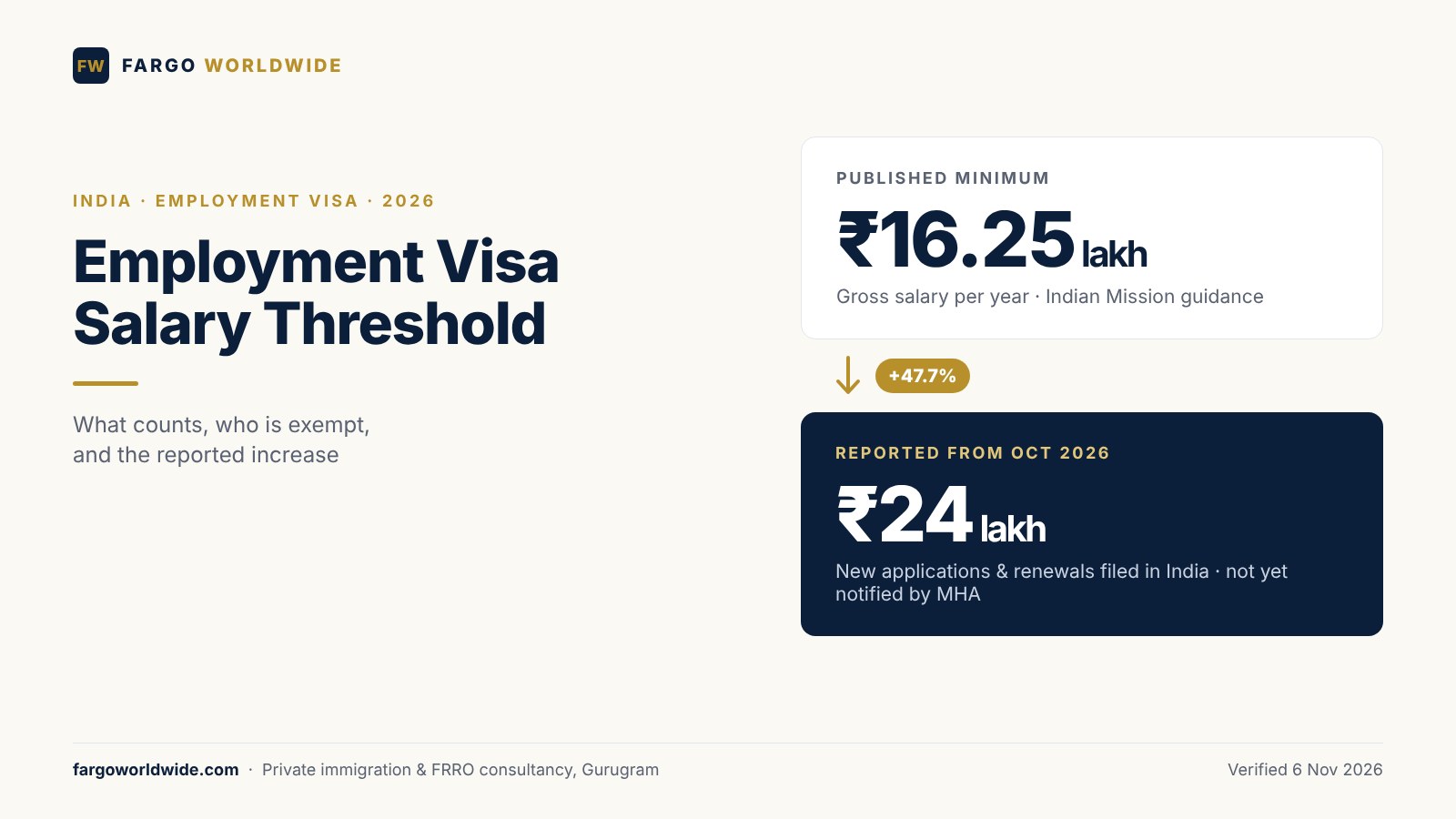
Employment Visa salary threshold 2026: published minimum ₹16.25 lakh versus reported ₹24 lakh from October 2026, a 47.7% increase

FRRO Registration for Korean Employment Visa Holders (2026)

FRRO Registration for Korean Employment Visa Holders (2026) Home › Blog › Employment Visa Registration for South Korean Nationals Indian Employment Visa Registration for South Korean Nationals: Complete FRRO and e-FRRO Guide (2026) By Devendra Kumar, Fargo Worldwide  |  Published: 13 October 2026  |  Official guidance last checked: 13 October 2026 Quick Answer A South Korean national who enters India on an Employment Visa valid for more than 180 days must generally apply for registration with the Foreigners Regional Registration Officer (FRRO) or Foreigners Registration Officer (FRO) within 14 days of arrival, under Rule 12 of the Immigration and Foreigners Rules, 2025. The application is made online through the e-FRRO portal or the official Indian Visa Su-Swagatam app, with your passport, visa, Indian address details and employer documents. The authority may request more information, an interview or biometrics. Visas valid for 180 days or less, and visas carrying a specific endorsement, follow different rules, so always read your own visa and confirm current official guidance. Moving to India for work is a big step. For many Korean engineers, managers and technical specialists, the flight, the new apartment and the first week at the plant or office take up most of the attention. The immigration paperwork that follows arrival is easy to underestimate, especially when the forms, the terminology and the online portal are all unfamiliar. That is where problems usually start. A rental agreement in a landlord’s name that does not match the address entered online. An appointment letter that lists a different designation from the one on the visa application. A request from the registration office for a revised employer undertaking, sent to an email inbox nobody is checking. None of these is dramatic on its own, but each can slow down a registration that has a fixed legal deadline. This guide explains FRRO registration for Korean employment visa holders in plain English. It covers who needs to register, how the e-FRRO system works, which documents are typically involved, what employers can do to help, and what to do if something goes wrong. It is written for Korean professionals themselves and for the HR teams, global mobility managers and Indian subsidiaries that support them. One point before we begin: India’s immigration framework changed recently. The Immigration and Foreigners Rules, 2025 (notified on 1 September 2025) replaced the old Registration of Foreigners Rules, 1992, and the rules were amended again in June 2026. Older blogs and checklists you find online may describe the previous system. Everything below was checked against official sources on 13 October 2026. Need Assistance With Indian Employment Visa Registration? Get a document checklist tailored to your visa, employer and city before you file. Request an FRRO Document Checklist WhatsApp Us In this guide What is an Indian Employment Visa? Do South Korean nationals need FRRO registration? FRRO registration vs. e-FRRO Step-by-step registration process Documents required Employer responsibilities Common problems and how to handle them How long does registration take? Fees and other costs Working before registration is complete Delayed or pending applications Registration, extension and change of details Why professional assistance can help How Fargo Worldwide assists Pre-submission checklist Frequently asked questions 1. What Is an Indian Employment Visa? An Indian Employment Visa (E visa) is the visa category issued to a foreign national who will take up employment in India with an Indian company or organisation. It is a regular (paper) visa applied for through the Indian Visa Online portal and processed by an Indian Mission, such as the Embassy of India in Seoul. According to the official visa provisions table, it is generally granted for one year or the period of the contract, allows multiple entries, requires proof of employment, and can be extended in India. Who typically qualifies Eligibility is set by the Ministry of Home Affairs and applied by the Indian Mission. In broad terms, the visa is meant for skilled and qualified professionals engaged by an Indian entity. Official Mission guidance, for example the Embassy of India in Dublin’s Employment Visa page, states that the applicant’s annual salary should not be less than USD 25,000, with listed exceptions. Korean applicants should confirm the current conditions with the Embassy of India in Seoul, because Missions publish their own procedural details. Common situations involving Korean nationals Korean companies have a large manufacturing, engineering and technology footprint in India. Typical Employment Visa situations include: Engineers and plant specialists posted to an Indian subsidiary of a Korean manufacturer. Managers and executives seconded to lead an Indian operation. Technical experts supporting installation, commissioning or quality control under an Indian employment contract. Professionals hired directly by an Indian company that has no Korean parent at all. The employer’s role The Indian employer or sponsoring organisation is central to the Employment Visa. It issues the appointment letter or contract used in the visa application, and it usually provides letters, undertakings and company records later, during registration and any extension. In practice, a Korean employee rarely completes registration without some input from the Indian entity. Employment Visa vs. Business Visa The difference matters, because the two categories carry different permissions and registration triggers. Point Employment Visa Business Visa Core purpose Taking up employment with an Indian entity Business activities such as meetings, negotiations and sales visits, not regular employment Sponsor Indian employer / organisation Indian business contact or the applicant’s own company, depending on the case Registration Generally required within 14 days of arrival when the visa is valid for more than 180 days Depends on visa validity and any stipulation on length of each stay; often required only if the person will stay beyond 180 days Korean nationals are also eligible for India’s Visa-on-Arrival facility, which the Embassy of India in Seoul notes is available for business, tourism, conference and medical travel. It is not a route to employment. If the purpose of your stay is paid work for an Indian entity, the Employment Visa is the category to discuss with the Mission and your employer. Read

FRRO Registration for Korean Employment Visa Holders (2026) Read More »

FRRO registration for Korean employment visa holders 2026 guide with Korean flag, passport and employment visa document

E-1 vs E-2 vs E-3 Employment Visa India 2026: Which Are You?

Employment Visa India · 2026 Update E-1, E-2, E-3 Employment Visa India (2026): Which Category Do You Fall Under? By Devendra Kumar Arya, Director, Fargo Worldwide  ·  Last verified: 25 August 2026  ·  9 min read In June 2026 the Ministry of Home Affairs quietly reshuffled India’s employment visa categories. If you were hired directly by an Indian company, transferred from a parent company abroad, or posted to India by an NGO or religious body, the letter on your visa sticker may no longer mean what it did last year. Here is what changed, who goes where, and what you and your employer need to do about it. Key facts at a glance What changed Employment visa sub-categories collapsed from four (E-1 to E-4) to three (E-1, E-2, E-3) Effective from 1 June 2026, Immigration and Foreigners (Amendment) Rules, 2026 E-1 All standard employment, including direct hires, consultants and intra-company transferees E-2 Personnel employed by registered NGOs E-3 Missionaries, religious workers and approved organisations E-4 (old project visa) Removed as a separate category Salary floor Gross ₹24 lakh per year for most E-1 roles since October 2026 (previously ₹16.25 lakh; exemptions exist) FRRO registration Within 14 days of arrival if your visa allows a stay of more than 180 days (unchanged). On visas of up to 180 days, register before day 180: the old 14-day grace after day 180 no longer exists. Official source mha.gov.in · indianfrro.gov.in What actually changed in June 2026? For years India ran four employment visa sub-types. E-1 covered ordinary employment and consultants, E-2 was for intra-company transferees, E-3 was for NGO staff and E-4 was for project workers, mostly in power and steel. In practice the lines blurred. We regularly saw an engineer seconded from a Korean parent company arrive on an E-1 while his colleague on the same project held an E-2, and both of them needed the same documents at FRRO anyway. The Immigration and Foreigners (Amendment) Rules, 2026, notified in the Gazette on 1 June 2026 under the Immigration and Foreigners Act, 2025, simplified this. The E-4 category was dropped. Intra-company transferees moved into E-1 alongside everyone else in regular employment. E-2 was narrowed to NGO personnel, and E-3 to missionaries, religious workers and organisations the government has specifically approved. The same amendment also removed the 14-day grace period that used to apply after day 180. This mainly affects people on visas of up to 180 days who need to stay longer: they must now register before day 180. If your Employment Visa allows a stay of more than 180 days, nothing has changed: you must still register with the FRRO within 14 days of arrival. We cover both deadlines below, because in our experience this is the change most likely to catch people out. Old vs new India employment visa categories, 2026 Before June 2026 there were four categories E-1 to E-4. After, three: E-1 for all standard employment including intra-company transfers, E-2 for NGO staff, E-3 for missionaries and approved organisations. Employment visa categories: before and after 1 June 2026 BEFORE E-1Direct employment & consultants E-2Intra-company transferees E-3NGO personnel E-4Project workers (power, steel) AFTER E-1All employment incl. intra-company transfers E-2Registered NGO personnel E-3Missionaries, religious & approved organisations E-4 removed — project roles now handled under E-1 or the Project Visa Source: Immigration and Foreigners (Amendment) Rules, 2026 · fargoworldwide.com Figure 1: How the four old employment visa categories map to the three new ones. E-1 vs E-2 vs E-3: side-by-side comparison Category E-1 E-2 E-3 Who it is for Skilled professionals employed by an Indian company, consultants on contract, and staff transferred from a foreign parent, subsidiary or group company Foreign nationals employed by a registered NGO in India Missionaries, religious workers and personnel of organisations specifically approved by the Government of India Sponsor in India The Indian employer or host company The registered NGO (FCRA compliance usually checked) The religious body or approved organisation; often needs MHA clearance Salary requirement Gross ₹24 lakh/year since October 2026, including quantified perquisites. Exemptions for ethnic cooks, language teachers (not English), embassy staff and some others Lower threshold applies; verify the current figure with the mission at the time of application Typically no commercial salary test, but proof of support and purpose is required Validity Up to the contract period, typically 1–2 years initially, extendable at FRRO to 5 years in total Usually 1 year, extendable Usually 1 year, extendable; missionary stays are closely monitored FRRO registration Mandatory. Within 14 days of arrival if your visa allows a stay of more than 180 days. Mandatory, same deadline Mandatory, same deadline; some jurisdictions call applicants in person Core documents Appointment letter, employment contract, employer’s undertaking, company incorporation/GST/PAN, proof of qualifications, salary proof NGO registration, FCRA certificate, appointment letter, undertaking Invitation from the religious body or approved organisation, purpose letter, MHA approval where required Change of employer Allowed within group companies in some cases; otherwise prior MHA approval Prior approval needed Prior approval needed Dependents Spouse and children on X-1 (Entry) visa, co-terminus with the principal Same Same A note on the salary figure. From October 2026, a minimum of ₹24 lakh per year applies to new Employment Visa applications and renewals filed in India (it was ₹16.25 lakh from 2018). No official MHA notification of the new salary figure has been published yet, and some Indian missions abroad still show the older figure. including some on our own site, still quote USD 25,000. Use the rupee figure and confirm with the mission where you are applying, because it is revised from time to time and some consulates round it differently. Which category applies to me? Five real-world scenarios These are drawn from the kind of cases we handle every week for corporate clients in Gurugram, Noida, Pune and Chennai. Names are changed; the situations are not. E-1Hired directly by an Indian company. Kim, a Korean process engineer, receives an offer letter from an Indian manufacturing firm in Haryana at ₹22 lakh a year.

E-1 vs E-2 vs E-3 Employment Visa India 2026: Which Are You? Read More »

E-1, E-2, E-3 Employment Visa India 2026 Which Are You

Employment Visa for India 2026: Fees, Letters & FAQs

Employment Visa for India 2026: Fees, Documents, Letters & FAQs Fargo Worldwide · Immigration Guides · Updated 14 Aug 2026 Employment Visa for India: The Complete 2026 Guide to Eligibility, Documents, Letters & Fees Everything a foreign professional or sponsoring Indian company needs to know before applying for an Indian Employment Visa — salary threshold, application process, letter formats, government fees and High Commission/VFS addresses. DA Devendra Kumar Arya Director, Fargo Worldwide · Gurugram, India $25KMin. annual salary threshold (USD) 4Sub-categories: E-1, E-2, E-3, Project Visa 14Days to complete FRRO registration 5 yrsMaximum extendable validity Home › Blog › Employment Visa for India: Complete 2026 Guide On this page 1. Overview 2. What Is an Employment Visa? 3. Benefits of an Employment Visa 4. Who Can Apply 5. Application Process 6. Documents & Letters Needed 7. Government Fee 8. High Commission / VFS / ICAC Addresses 9. Letter Formats 10. Conclusion 11. 20 FAQs 12. About the Author 1. Overview For a foreign professional joining an Indian company, or an Indian entity bringing in specialised overseas talent, the Employment Visa is the only lawful route — a Business Visa or Tourist Visa simply will not cover paid work in India, and using the wrong category is one of the fastest ways to get an application flagged or a company blacklisted from future sponsorship. This guide walks through what the Employment Visa actually is, who qualifies, the documents and letters a sponsoring company needs to prepare, current government fees, and where to submit an application — country by country. At Fargo Worldwide, we prepare Employment Visa documentation for foreign hires across technology, manufacturing and consulting every month, and this article reflects what we actually see work — and what routinely causes delays. 2. What Is an Employment Visa? An Employment Visa is granted to a foreign national who is a “highly skilled and/or qualified professional” being engaged by a registered Indian entity, for a role that cannot easily be filled by local talent. It permits the holder to legally reside and draw a salary in India for the duration of their employment contract. It is commonly split into sub-categories: Common Sub-Categories E-1 — direct employment with an Indian company E-2 — intra-company transfer of an expatriate employee E-3 — employment with an NGO Project Visa — specialists/technicians on defined power or steel-sector projects Not the Same As Business Visa — commercial visits, no employment Entry (X) Visa — dependants; residence but not work e-Visa — short-term, non-employment purposes only 3. Benefits of an Employment Visa Legal, salaried work in India — the only visa category that permits drawing an Indian salary. Multi-year presence — issued for up to one year or the contract length, and extendable via FRRO up to five years. Dependant coverage — spouse and children can accompany on an Entry (X) Visa. Path to long-term compliance — supports tax residency planning, PAN card issuance and continued FRRO-registered stay. Company credibility — sponsoring correctly (rather than misusing a Business Visa) protects the Indian entity from penalties and blacklisting. 4. Who Can Apply for an Employment Visa? Eligibility centres on two things: a genuine sponsoring Indian entity, and meeting the salary threshold (with defined exemptions). Salary threshold — visualised Standard thresholdUS$25,000 / yr IIT/IIM/NIT/IISER faculty₹9.10 lakh / yr PIO/spouse of Indian citizen₹3.60 lakh / yr Ethnic cooks / non-English teachers / embassy staffExempt Bars are illustrative proportions relative to the standard US$25,000 benchmark, not exact currency conversions. Confirm exact figures with the Indian Mission at the time of application. Eligible profiles include senior executives, technical specialists, IT/engineering professionals, academic faculty (at the specified institutions), consultants engaged on a fixed-fee contract basis, and intra-company transferees. Not eligible: routine clerical or manual roles that can be filled locally, and general BPO/ITES staff (who are not eligible for the salary-threshold exemption even in listed categories). The sponsoring employer must be a registered Indian entity — a private limited company, LLP, branch/liaison/project office, or an Indian client formally engaging a foreign consultant. Foreign companies without an Indian legal entity generally cannot sponsor an Employment Visa directly. Hiring a foreign national for your Indian entity? Fargo Worldwide prepares complete Employment Visa documentation — contracts, undertaking letters, salary certificates and FRRO filings — so your application goes in clean the first time. WhatsApp Our Team Book a Consultation 5. Application Process 1Confirm eligibilityVerify salary threshold, role type and sponsoring entity status. 2Prepare employer lettersContract, undertaking letter, company registration proof. 3Complete online formindianvisaonline.gov.in/visa — print and sign for regular visa. 4Submit at Mission/VFS/BLSBy appointment, with biometrics where required. 5Mission decisionApproval rests solely with the Indian Mission — not the service provider. 6Arrive & register with FRROWithin 14 days of arrival if the stay exceeds 180 days. India processes a very high volume of Employment Visa applications annually, with indicative processing windows commonly cited around 10–30 working days — but this depends heavily on nationality, role and documentation completeness, and is never guaranteed. 6. Documents & Letters Needed to Apply From the Applicant Passport valid 6+ months with blank pages Compliant photograph (51×51mm, plain background) Signed online application form Proof of qualifications / professional experience Signed employment contract or appointment letter CV/resume supporting the specialised role claim From the Sponsoring Indian Company Certificate of Incorporation / company registration Company undertaking/sponsorship letter Board resolution or authorisation, where applicable Salary certificate confirming the annual package Company profile / latest financials, if requested GST or other registration proof, where applicable Need these drafted correctly the first time? Get in touch with our team — incomplete or inconsistent employer letters are the single most common reason Employment Visa applications stall. 7. Government Fee for Employment Visa The Employment Visa is issued as a regular (paper) visa — there is no e-Visa route for employment. This means the government fee follows the same nationality-based reciprocity schedule that each Indian Mission publishes for regular visas generally (the same table used for Business and other paper-visa categories for that country), rather than one flat

Employment Visa for India 2026: Fees, Letters & FAQs Read More »

Regular Employment Visa for India | Complete 2026 Guide

Employment Visa: Request Letter Format

Employment Visa India : Request Letter Template Employment Visa India : How to Prepare a Request Letter? Employment Visa: Request Letter Template Employment Visa issued by the Government of India to foreign nationals to work in India for up to 5 years. An Employer with a visa validity of more than 180 days needs to register their visa with the FRRO within 14 days of arrival in India, and this is taken care of by the FRRO in India. Also, if an Employment Visa holder needs to extend it, they need to apply for a Visa Extension application over the FRRO portal. For a complete application filling, the applicant needs to inform the FRRO of the duration of stay and entry validity, so they need to write a letter. Here we are sharing a request letter format that will help you to get a visa extension in India. Employment Visa : Why is the Request Letter needed for e-FRRO application? The Request Letter is a formal way to share your information and request to FRRO. Here are the key points that you have to keep in mind when preparing a Request Letter: Date and Time: Mention the date and time of writing the Request Letter. Address to FRO/FRRO: Request the address to the FRO/FRRO office at the top of the page. Subject: Highlight your request and mention your name, duration of stay, and visa type. Salutations: The most widely used salutation is “Dear Sir/Ma’am.”Mention your information: Mention the applicant’s name, Passport number, visa number, date of issue, and date of expiry. Highlight the points: Highlight your points about the major point.Mention your company name and address.Duration of stay in India. Justification: Highlight your education and work experience along with the reason for visa extension. Supporting documents: Mention the details of the supporting documents as per your request. Conclusion: Reiterate your request and express your gratitude. Employment Visa : Pro Tips for Success Be Clear and Concise: Use simple language, so everyone can understand, and it is easy to read. Be Professional: Maintain a formal tone throughout the request letter. Be Accurate: Double-check all information and provide accurate information about the applicant and company. Proofread Carefully: Errors can create a negative impression on your application. Include all requested documents: Mention all the attached documents. What is Employment Visa? Employment Visa: A Request Letter Template [Company Letterhead] Date: 27 September 2025 To,FRO/FRRO[Address with PIN Code] Subject: Request for Employment Visa Registration / Employment Visa Extension of Mr. ———————- Dear Sir/Madam, This is to formally request the extension of the Visa for Mr./Ms. ———————-, a citizen of ———————-, holding Passport No. ———————- (issued on –/–/—-, valid until –/–/—-) and Indian Visa No. ———————- (issued on –/–/—-, valid until –/–/—-). He/She is currently employed with —————————————————————- as a ————————————– in India. Salary: Receiving ———————- from ———————- in India. Employment Contract: —————————————————— (copy attached). Residential Address: ——————————————————. Enclosures: Copy of current Passport & Visa Copy of renewed employment contract During his/her stay in India, he/she has complied with all laws and regulations and will continue to maintain good conduct. He/She remains committed to working with ———————- and contributing positively to both the company and the local economy. We kindly request that you process the extension of his/her Employment Visa at the earliest. All applicable charges will be duly paid. We assure you that he/she will continue to adhere to the rules and regulations of India. We would greatly appreciate your consideration of this request. Thank you. Yours faithfully, [Company Name][Authorized Signatory][Company Seal/Stamp][Contact Number] Conclusion A Request Letter for Employment Visa Extension in India A Request Letter is an important document required for an Visa extension in India. It is issued by the FRRO (Foreigners Regional Registration Office), and depending on the visa type, the FRRO may ask for additional details or supporting documents. Please note that the format is only a guideline to help you prepare your letter. At Fargoworldwide, our team specializes in assisting foreign nationals with FRRO services in India, including visa registration, extensions, and compliance support. 👉 Know More — Employment Visa https://youtu.be/cQ639JT21EY?si=FHCGtpgmwNlLW9Ce

Employment Visa: Request Letter Format Read More »

Employment Visa: Request Letter Format - Fargo Worldwide
Scroll to Top