
FRRO

Guides to FRRO and FRO registration in India for foreign nationals: who must register, the e-FRRO process, deadlines, Form C / Form III and recent rule changes. Written by Fargo Worldwide, a private immigration consultancy in Gurugram.

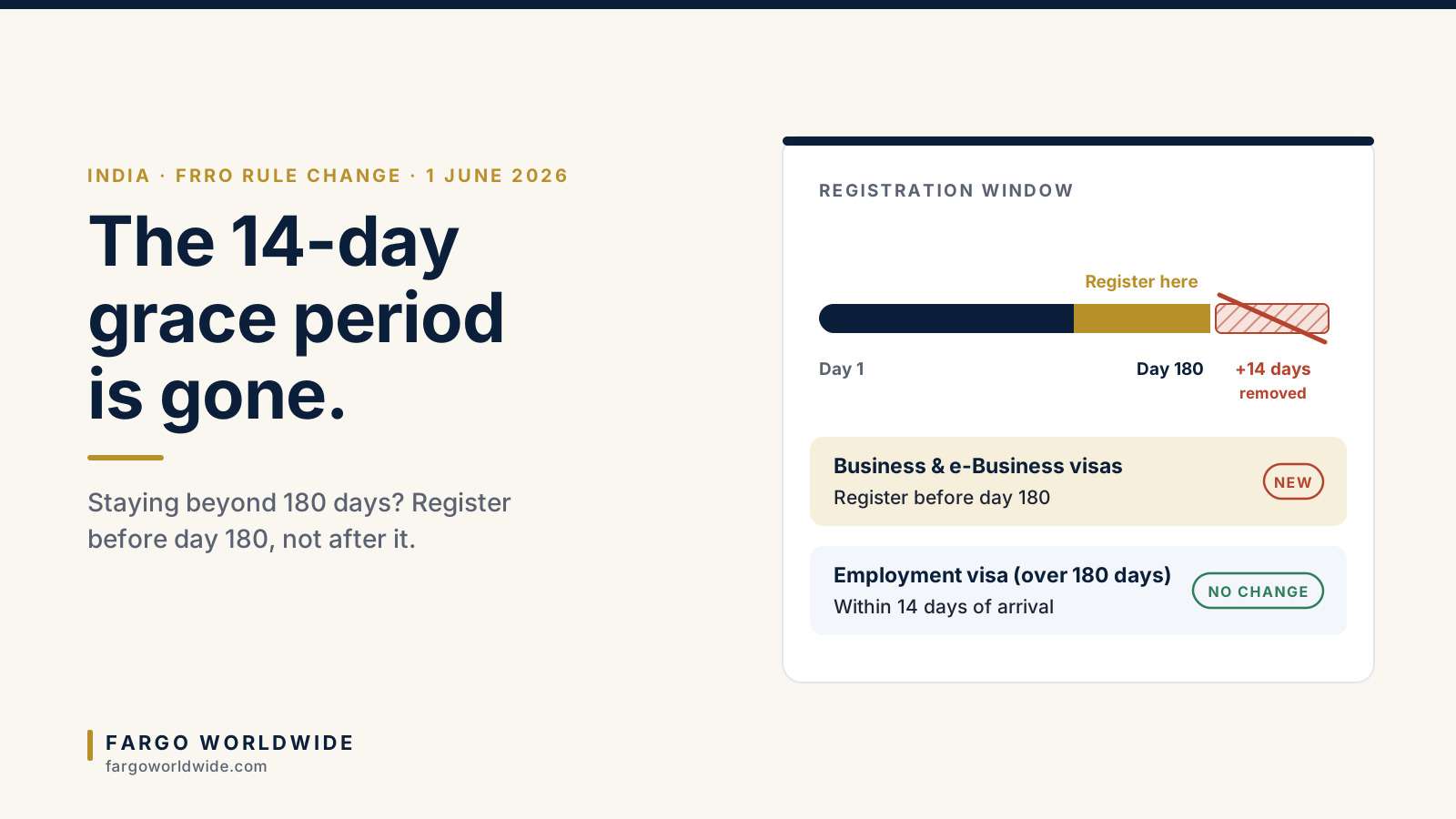
FRRO’s 14-Day Grace Period Is Gone: What the June 2026 Rule Change Means for Business & Employment Visa Holders

FRRO 14-Day Grace Period Gone: Business & Employment Visas (2026) FRRO’s 14-Day Grace Period Is Gone: What the June 2026 Rule Change Means for Business & Employment Visa Holders By Devendra Kumar Arya, Director, Fargo Worldwide · Last verified: 29 October 2026 · 14 min read Since 1 June 2026, the extra 14 days after day 180 no longer exist. Registration has to be filed before day 180. The FRRO 14-day grace period that business travellers and project teams relied on for years ended on 1 June 2026. Until then, a foreigner who wanted to stay in India beyond 180 days could register with the FRRO up to 14 days after the 180th day. Now the application has to be filed before day 180 runs out, and late registration is allowed only in emergent circumstances. The change has caused a lot of confusion, especially among HR teams. Some websites now claim that Employment visa holders have also lost their 14-day registration window. That is not correct. This guide separates the two “14-day” rules, explains exactly what changed for Business and Employment visa holders, and shows how to plan registrations so that nobody in your team is stopped at the airport. Quick Answer: Is the FRRO 14-Day Grace Period Really Gone? Yes, but only the 14 days that came after day 180. Business visa and e-Business visa holders who want to stay beyond 180 days, on one visit or in total in a calendar year, must now register on e-FRRO before day 180. Employment visa holders whose visa is valid for more than 180 days are not affected: they still register within 14 days of arrival, as before. At a glance Question Short answer What changed? Rule 12(1) of the Immigration and Foreigners Rules, 2025 was amended. Registration to stay beyond 180 days must be done any time before the 180 days end, not within 14 days after. Since when? 1 June 2026, through the Immigration and Foreigners (Amendment) Rules, 2026 (G.S.R. 424(E)). It applied immediately. Who is most affected? Business and e-Business visa holders, and anyone on a visa valid for 180 days or less who needs to stay longer. Are Employment visa holders affected? Not if the visa is valid for more than 180 days. They still register within 14 days of arrival. Can I register late? Only in emergent circumstances, and approval is not guaranteed. What if registration is refused? A new online appeal to the Commissioner, Bureau of Immigration, filed within 30 days of the order. Maximum legal penalty for breaking the rules Up to 3 years’ imprisonment, a fine of up to ₹3 lakh, or both (Section 23 of the Immigration and Foreigners Act, 2025). What Exactly Changed on 1 June 2026 Since 1 September 2025, the stay and registration of foreigners in India have been governed by the Immigration and Foreigners Act, 2025 and the Immigration and Foreigners Rules, 2025. These replaced the Foreigners Act, 1946 and the Registration of Foreigners Rules, 1992, so any advice that still quotes the old laws is out of date. On 1 June 2026, the Ministry of Home Affairs notified the Immigration and Foreigners (Amendment) Rules, 2026 as G.S.R. 424(E). According to BDO India’s immigration alert, the amendment changed the registration timeline in Rule 12(1) and added a digital appeals process. The registration deadline: old wording vs new wording Before 1 June 2026: a foreigner on a visa valid for 180 days or less, who wanted to stay longer, could register within fourteen days after the expiry of 180 days from arrival. From 1 June 2026: registration must be done “any time before the expiry of the said period of one hundred and eighty days”. Registration after that is allowed only in emergent circumstances, as reported by All India Radio News. Long-term visas with a stay cap: the same rule covers visas valid for more than 180 days that carry the condition “each stay shall not exceed 180 days”. This is the condition printed on most multi-year Business visas. The registration window now closes at day 180 instead of day 194. Situation Before 1 June 2026 From 1 June 2026 Visa valid 180 days or less, need to stay longer Register within 14 days after day 180 Register before day 180 ends Multi-year Business or e-Business visa, stay will cross 180 days Older guidance, such as MHA’s e-Business conditions, allowed registration within two weeks after day 180 Register before day 180 ends, per visit or calendar-year total Registration after the deadline Possible within the 14-day window Only in emergent circumstances Employment visa valid for more than 180 days Register within 14 days of arrival Register within 14 days of arrival (unchanged) Challenging an order of the civil authority No online appeal in the Rules Online appeal to the Commissioner, Bureau of Immigration, within 30 days Which 14 Days Are Gone, and Which Still Apply Two different 14-day rules exist in Indian registration law, and the June 2026 amendment removed only one of them. 14 days after arrival (still in force). Foreigners on visas valid for more than 180 days, such as Employment, Student, Research and long-term Entry (X) visas, must register within 14 days of arriving in India. The amendment did not touch this rule. BDO’s alert says it does not affect foreign nationals who already had to register within 14 days of arrival, and names Employment visa holders and their dependants. 14 days after day 180 (removed). This was the extra window for people on shorter visas, or on visas with a 180-day stay cap, who decided to stay longer. It no longer exists. Courts still apply the first rule closely. In Wu Jyun Lin v. FRRO (Bombay High Court, 28 July 2026), a former E-2 Employment visa holder who later moved to a Student visa had applied for registration 12 days after arrival. The court noted that the application was filed within the 14-day period, held that the ₹50,000 penalty demanded was not warranted, and quashed
FRRO’s 14-Day Grace Period Is Gone: What the June 2026 Rule Change Means for Business & Employment Visa Holders Read More »

FRRO 14-day grace period gone: Business visa registration must be filed before day 180, Employment visa still within 14 days of arrival

Form C Is Now Form III: Complete Guide for Landlords & Hosts in India (2026)

Fargo Worldwide service We file Form III (Form C) for you For landlords, hotels, PGs and companies hosting a foreign national. We check the guest’s passport and visa, file Form III on the e-FRRO portal and send you the acknowledgement. ₹2,500 per application WhatsApp us to file Form III Leaving India and your Form C is missing? See what to do. Accommodation Reporting · 2026 Update By Devendra Kumar Arya, Director, Fargo Worldwide · Last verified 22 October 2026 · 17 min read If you run a hotel, PG, homestay or company guest flat, you have probably filed a “C-Form” for a foreign guest. Since 1 September 2025, that report has a new legal basis and a new name: the Immigration and Foreigners Rules, 2025 call it Form III, and the official form is labelled “[Earlier FORM ‘C’]”. The portal still says “C-Form” in places, so the change is easy to miss. Key facts at a glance What changed Form C is now Form III In force from 1 September 2025 Legal basis Section 8 of the Immigration and Foreigners Act, 2025; Rule 17 of the Rules, 2025 Who files The keeper of accommodation, not the foreign guest Arrival report Within 24 hours of arrival Departure report Within 24 hours of departure Records Kept electronically for at least one year OCI cardholders Included Official source Rules, 2025 (MHA) · Act, 2025 (India Code) Quick Answer — What Is Form III in India? Form C is now Form III: it is the accommodation report that replaced the old Form C under the Immigration and Foreigners Rules, 2025. The keeper of accommodation — a hotel, guest house, PG, hostel, homestay, rented accommodation, hospital or other covered premises — must send it to the Registration Officer through the FRRO portal or the Indian Visa Su-Swagatam app no later than 24 hours after a foreign national, including an OCI cardholder, arrives. Departure details must follow within 24 hours of departure. Not sure whether the report sits with you, your company or the landlord? Request guidance from Fargo Worldwide. Form C Is Now Form III: What Changed in 2025-2026? The new name is only the visible part; the legal framework changed too. Form C to Form III Before 1 September 2025, accommodation reports were Form C under the Foreigners Act 1946 and Registration of Foreigners Rules 1992. From 1 September 2025 they are Form III under the Immigration and Foreigners Act and Rules 2025. The June 2026 amendment left Rule 17 unchanged. BEFORE 1 SEPT 2025 Foreigners Act, 1946 Registration of Foreigners Rules, 1992 Form C 1 Sept 2025 FROM 1 SEPT 2025 Immigration and Foreigners Act, 2025 and Rules, 2025 Form III labelled “[Earlier FORM ‘C’]” 1 June 2026 amendment (G.S.R. 424(E)): Rule 17 unchanged Figure 1: The same report under a new law and a new name. Topic Earlier position Current position Practical implication Legal basis Foreigners Act, 1946; Registration of Foreigners Rules, 1992 Immigration and Foreigners Act and Rules, 2025, from 1 September 2025 Update tenancy clauses and SOPs that cite the old laws. Form name Form C Form III, labelled “[Earlier FORM ‘C’]” Same purpose; the portal may still say “C-Form”. Reporting window Form C within 24 hours of arrival Arrival within 24 hours (Rule 17(5)); departure within 24 hours of leaving (Rule 17(6)) Check-out is a second filing. Records Guest register kept by the host Kept electronically for at least one year, open to inspection (Rule 17(1)–(2)) Keep digital records. OCI cardholders Not expressly named in the reporting rule Expressly included (Rules 16, 17 and 18) Report OCI guests too. Private homes Depended largely on local orders Non-commercial residential premises excluded by Section 8(1), unless an area direction under Section 8(3) applies Check local directions before assuming you are exempt. 2026 amendment — G.S.R. 424(E) (1 June 2026) changed registration timelines, child reporting and appeals; Rule 17 unchanged Accommodation duties stand as notified in 2025. For the June 2026 changes to foreigners’ own registration, see our summary of the FRRO new guidelines for 2026. What Is Form III and Why Is It Required? Form III is a short electronic report telling the Registration Officer that a foreign national is staying at your premises, why they are in India, where they came from and, later, where they went. The duty comes from Section 8 of the Act, and the reporting method is set out in Rule 17 of the Rules. These reports show the authorities where foreign nationals are staying and help them spot overstays. They matter to guests too: FRRO offices often ask for the landlord’s or hotel’s Form C confirmation with registration and extension applications, so a missing report can hold up the guest’s case. Who Must Submit Form III in India? The duty sits with the keeper of accommodation: under Section 2(j), the person in charge of managing the accommodation, or anyone they authorise. The foreign national does not file Form III, but under Section 8(2) they must give the keeper accurate particulars. Rule 17(7)(a) lists what counts as accommodation, and the list is not exhaustive. Hotels, resorts, guest houses and serviced apartments These are commercial accommodation and are squarely covered. Every foreign guest, including OCI cardholders, is reported within 24 hours of check-in and again within 24 hours of check-out. The keeper is usually the operator, even if someone else owns the building. PG accommodation, hostels and homestays Rule 17(7)(a) names “paying guest house”, “hostel”, “home stay” and “rented accommodation”. PG operators and homestay hosts, including those listing on booking platforms, should file for each foreign guest. Corporate accommodation and employer-arranged stays If a company houses a foreign employee in a flat or guest house it manages, the company may be the keeper. If a landlord or apartment operator manages the premises, the duty may sit with them. The Rules do not settle every arrangement, so agree in writing, in the lease or booking terms, who files the arrival and departure reports. Hospitals, nursing homes and medical institutions Under Section

Form C Is Now Form III: Complete Guide for Landlords & Hosts in India (2026) Read More »

Form C is now Form III: guide for landlords, hosts and foreign tenants in India

FRRO Registration for Korean Employment Visa Holders (2026)

FRRO Registration for Korean Employment Visa Holders (2026) Home › Blog › Employment Visa Registration for South Korean Nationals Indian Employment Visa Registration for South Korean Nationals: Complete FRRO and e-FRRO Guide (2026) By Devendra Kumar, Fargo Worldwide  |  Published: 13 October 2026  |  Official guidance last checked: 13 October 2026 Quick Answer A South Korean national who enters India on an Employment Visa valid for more than 180 days must generally apply for registration with the Foreigners Regional Registration Officer (FRRO) or Foreigners Registration Officer (FRO) within 14 days of arrival, under Rule 12 of the Immigration and Foreigners Rules, 2025. The application is made online through the e-FRRO portal or the official Indian Visa Su-Swagatam app, with your passport, visa, Indian address details and employer documents. The authority may request more information, an interview or biometrics. Visas valid for 180 days or less, and visas carrying a specific endorsement, follow different rules, so always read your own visa and confirm current official guidance. Moving to India for work is a big step. For many Korean engineers, managers and technical specialists, the flight, the new apartment and the first week at the plant or office take up most of the attention. The immigration paperwork that follows arrival is easy to underestimate, especially when the forms, the terminology and the online portal are all unfamiliar. That is where problems usually start. A rental agreement in a landlord’s name that does not match the address entered online. An appointment letter that lists a different designation from the one on the visa application. A request from the registration office for a revised employer undertaking, sent to an email inbox nobody is checking. None of these is dramatic on its own, but each can slow down a registration that has a fixed legal deadline. This guide explains FRRO registration for Korean employment visa holders in plain English. It covers who needs to register, how the e-FRRO system works, which documents are typically involved, what employers can do to help, and what to do if something goes wrong. It is written for Korean professionals themselves and for the HR teams, global mobility managers and Indian subsidiaries that support them. One point before we begin: India’s immigration framework changed recently. The Immigration and Foreigners Rules, 2025 (notified on 1 September 2025) replaced the old Registration of Foreigners Rules, 1992, and the rules were amended again in June 2026. Older blogs and checklists you find online may describe the previous system. Everything below was checked against official sources on 13 October 2026. Need Assistance With Indian Employment Visa Registration? Get a document checklist tailored to your visa, employer and city before you file. Request an FRRO Document Checklist WhatsApp Us In this guide What is an Indian Employment Visa? Do South Korean nationals need FRRO registration? FRRO registration vs. e-FRRO Step-by-step registration process Documents required Employer responsibilities Common problems and how to handle them How long does registration take? Fees and other costs Working before registration is complete Delayed or pending applications Registration, extension and change of details Why professional assistance can help How Fargo Worldwide assists Pre-submission checklist Frequently asked questions 1. What Is an Indian Employment Visa? An Indian Employment Visa (E visa) is the visa category issued to a foreign national who will take up employment in India with an Indian company or organisation. It is a regular (paper) visa applied for through the Indian Visa Online portal and processed by an Indian Mission, such as the Embassy of India in Seoul. According to the official visa provisions table, it is generally granted for one year or the period of the contract, allows multiple entries, requires proof of employment, and can be extended in India. Who typically qualifies Eligibility is set by the Ministry of Home Affairs and applied by the Indian Mission. In broad terms, the visa is meant for skilled and qualified professionals engaged by an Indian entity. Official Mission guidance, for example the Embassy of India in Dublin’s Employment Visa page, states that the applicant’s annual salary should not be less than USD 25,000, with listed exceptions. Korean applicants should confirm the current conditions with the Embassy of India in Seoul, because Missions publish their own procedural details. Common situations involving Korean nationals Korean companies have a large manufacturing, engineering and technology footprint in India. Typical Employment Visa situations include: Engineers and plant specialists posted to an Indian subsidiary of a Korean manufacturer. Managers and executives seconded to lead an Indian operation. Technical experts supporting installation, commissioning or quality control under an Indian employment contract. Professionals hired directly by an Indian company that has no Korean parent at all. The employer’s role The Indian employer or sponsoring organisation is central to the Employment Visa. It issues the appointment letter or contract used in the visa application, and it usually provides letters, undertakings and company records later, during registration and any extension. In practice, a Korean employee rarely completes registration without some input from the Indian entity. Employment Visa vs. Business Visa The difference matters, because the two categories carry different permissions and registration triggers. Point Employment Visa Business Visa Core purpose Taking up employment with an Indian entity Business activities such as meetings, negotiations and sales visits, not regular employment Sponsor Indian employer / organisation Indian business contact or the applicant’s own company, depending on the case Registration Generally required within 14 days of arrival when the visa is valid for more than 180 days Depends on visa validity and any stipulation on length of each stay; often required only if the person will stay beyond 180 days Korean nationals are also eligible for India’s Visa-on-Arrival facility, which the Embassy of India in Seoul notes is available for business, tourism, conference and medical travel. It is not a route to employment. If the purpose of your stay is paid work for an Indian entity, the Employment Visa is the category to discuss with the Mission and your employer. Read

FRRO Registration for Korean Employment Visa Holders (2026) Read More »

FRRO registration for Korean employment visa holders 2026 guide with Korean flag, passport and employment visa document

New Visa for a Newborn Foreign Child Born in India

New Visa for Newborn Foreign Child in India | e-FRRO Complete Guide New Visa for a Newborn Foreign Child Born in India 📄 Complete e-FRRO Guide 🔄 Updated 2026 ⏱️ 12 min read ✓ Expert Verified 🎯 Need expert help with your baby’s visa status? Get Free Consultation Having a baby in India as a foreign national creates important immigration responsibilities. Many parents assume that obtaining an Indian birth certificate completes the process, but this is only the first step. A foreign child born in India requires attention to immigration status, e-FRRO registration, visa documentation, passport processing, and legal compliance. This comprehensive guide explains what foreign parents need to know about obtaining a visa or immigration status for a newborn foreign child born in India, the e-FRRO process, required documents, timelines, fees, and how to ensure proper immigration compliance. We also address the different situation for children with Indian origin (where one or both parents hold Indian citizenship). Why This Guide Matters for Your Family ⚖️ Legal Compliance Ensure your baby has proper immigration status under Indian law 📋 Complete Roadmap Know exactly which documents and steps are required ✈️ Travel Ready Enable safe international travel with proper authorization ⏰ Save Time & Stress Avoid delays and confusion with a clear process What Happens When a Foreign Child Is Born in India? When a foreign national child is born in India, the child is born within Indian territory but typically holds the nationality of one or both parents (depending on applicable nationality laws). This creates a specific immigration scenario: the child is physically present in India but does not automatically hold Indian citizenship or valid Indian visa/status simply due to birth. From an immigration perspective, the birth of a foreign national child in India must be reported to and processed through the Foreign Regional Registration Office (FRRO)—the government agency responsible for monitoring and registering foreign nationals. The process is handled primarily through India’s e-FRRO system, an online application platform designed to streamline registration for dependents. The child’s immigration status in India is determined by: The child’s nationality (from their parents’ country of origin) The parents’ current Indian visa or immigration status The specific FRRO office’s interpretation of applicable rules Bilateral agreements between India and the child’s home country ⚠️ Important: Birth in India does not automatically grant the right to remain in India. An Indian birth certificate alone does not establish immigration status. Foreign parents must apply for appropriate visa documentation or FRRO registration to ensure the child’s lawful presence. Key Facts at a Glance 👶 Newborn Passport Child must have valid passport from home country 📅 Timeline 6-8 weeks typical for e-FRRO processing 💰 Cost Government fee typically free; private assistance optional 🔒 Status Most children receive Entry/X Visa or dependent registration Does a Newborn Foreign Child Need an Indian Visa? Quick answer: In most cases, yes—a newborn foreign child born in India will require an appropriate Indian visa or immigration status to remain legally in India, even though the child was born within Indian territory. 🔑 Critical Point: Birth in India does not confer the automatic right to remain in India. India’s immigration law treats foreign nationals—including newborn foreign nationals—as requiring valid visa or registration status for legal residence. However, the specific form of this status varies: Some newborns receive an “Entry Visa” or “X Visa” (dependent family member visa) Some require FRRO registration and intimation without a separate visa Some situations may fall under bilateral agreements between India and the child’s home country The child’s own nationality and parents’ visa category significantly influence the process The most common scenario is that the newborn will be registered with the FRRO through the e-FRRO system as a dependent of the foreign national parent(s), and the child’s status will be noted in Indian immigration records. Special Case: “New Visa” for Children with Indian Origin (Mixed Citizenship) 📌 Different Rules Apply: If one or both parents hold Indian citizenship or hold OCI (Overseas Citizen of India) status, the child’s situation is significantly different from a purely foreign newborn. If one parent is an Indian citizen: The child may have automatic eligibility for Indian citizenship (depending on when the child was born and applicable law) The child may not require a separate “visa” in the traditional sense The child’s immigration documentation will be handled differently—through citizenship channels rather than visa categories An Indian passport (rather than a foreign passport) may be appropriate FRRO registration requirements may be different or may not apply If one or both parents hold OCI status: The child’s eligibility for OCI status depends on the child’s nationality and parentage Special visa or immigration procedures may apply Consult the Ministry of External Affairs and the nearest Indian mission for guidance Action: If either parent is Indian or holds OCI status, do not assume the standard foreign newborn process applies. Instead, contact the nearest Indian mission (embassy or consulate) to understand the child’s specific citizenship and immigration options. This could significantly simplify or alter the immigration process. Why the Newborn’s Passport and Birth Certificate Matter 1. The Newborn’s Passport or Travel Document A newborn foreign child must have a valid passport or recognized travel document from their home country to apply for Indian visa or FRRO registration. This passport serves as: Proof of nationality – establishes the child’s citizenship Proof of identity – identifies the specific individual Basis for Indian visa/status – Indian authorities use passport details to issue visa or registration Common challenge: Obtaining a newborn’s passport can take weeks or months. Many parents are surprised that their embassy requires substantial documentation (birth certificate, parent passports, proof of parentage, citizenship forms) before issuing a passport. Action: Begin passport application immediately after birth. This is often the longest single step in the overall process. 2. The Indian Birth Certificate An Indian birth certificate serves multiple purposes: Proof of birth in India – required by FRRO to confirm the child was born within Indian territory Identity corroboration – establishes the

New Visa for a Newborn Foreign Child Born in India Read More »

new visa for newborn foreign child in india

FRRO New Guidelines 2026: Everything Foreign Nationals in India Must Know

FRRO New Guidelines 2026: Everything Foreign Nationals in India Must Know India has rewritten part of its foreigner-registration rules. If your visa allows stays of up to 180 days, the 14-day grace period after day 180 is gone. Employment visa sub-categories have been relabelled, and the reporting rules for mixed-citizenship families have changed. Here is what actually changed, who it affects, what stays the same, and what to do next. Last updated: 26 November 2026 Reading time: 15 minutes Author: Devendra Kumar, Director, Fargo Worldwide Checked against: MHA Gazette notification of 1 June 2026 In short: From 1 June 2026, if you entered India on a visa that allows stays of up to 180 days (or on a longer multiple-entry visa where each stay is capped at 180 days) and you want to stay longer, you must register with the FRRO or FRO before day 180. The old 14-day grace period after day 180 is gone, and late registration is accepted only in emergent circumstances. Unchanged: long-term visas valid for more than 180 days, such as Employment, Student and Research visas, must still be registered within 14 days of arrival. Also new: Employment visa sub-categories were relabelled (E-1, E-2, E-3), birth reporting for children with an Indian parent was relaxed with a new 30-day duty, and appeals moved online. If you searched for this article, there is a good chance someone told you the rules changed, and they did not exaggerate. On 1 June 2026, the Ministry of Home Affairs notified the Immigration and Foreigners (Amendment) Rules, 2026. This Gazette notification changed three parts of the compliance framework foreign nationals in India rely on: the FRRO/FRO registration timeline for shorter visas, the birth-reporting obligations for families with mixed Indian and foreign citizenship, and the appeals process available to anyone aggrieved by a civil authority’s direction. In the same month, the Employment visa sub-categories on the Indian visa portal were also relabelled. None of this was rolled out with much fanfare. Many foreign nationals, and a fair number of consultants, are still working off the old “register within 14 days after day 180” rule. This guide breaks down exactly what changed, why it matters, and what you need to do differently. If you are already working with our team on an FRRO registration or visa extension, this article explains the update behind the revised timelines you may have heard about. For context, foreigner registration in India has always sat somewhat apart from your visa itself. Your visa is what a consular officer issues before you travel; FRRO registration is a separate, domestic compliance step that the Bureau of Immigration, under the Ministry of Home Affairs, uses to keep a live record of foreign nationals staying in the country long-term. For decades this was governed by the Registration of Foreigners Act, 1939, the Foreigners Act, 1946 and the Registration of Foreigners Rules, 1992. The Immigration and Foreigners Act, 2025 and the Immigration and Foreigners Rules, 2025, in force since 1 September 2025, replaced that older framework. The June 2026 amendment is the first significant revision to the new framework, which is exactly why it is worth reading carefully rather than assuming “the FRRO process” works the way it always has. It is also worth being clear about who issued this change and on what authority, since misinformation tends to circulate whenever immigration rules shift. This amendment was notified through an official Gazette notification by the Ministry of Home Affairs. It is not a policy proposal, a leak, or a state-level circular. It came into force on publication, so there was effectively no transition window. If your 180-day period straddles 1 June 2026, confirm with a consultant which framework applies to your case. What This Article Covers What Changed on 1 June 2026: The Full Picture The New 180-Day Registration Rule, Explained Old Rule vs New Rule: Side-by-Side Comparison Employment Visa Sub-categories Relabelled: E-1, E-2, E-3 Revised Birth-Reporting Rules for Mixed-Citizenship Families The New Online Appeals Process Who Is Affected, and Who Is Not FRRO Jurisdictions Across India: Where to Register Key Terms Used in the New Rules: A Quick Glossary How to Register Under the New Rules (Step by Step) Documents You Still Need: Updated Checklist Penalties and Consequences When to Start: A Practical 180-Day Timeline Common Mistakes to Avoid Under the New System Why Work With Fargo Worldwide for FRRO Compliance Frequently Asked Questions Official Sources 1. What Changed on 1 June 2026: The Full Picture The Immigration and Foreigners (Amendment) Rules, 2026 amend the Immigration and Foreigners Rules, 2025, which had already replaced the decades-old registration law. The amendment came into force immediately and touches three areas: Registration timeline (Rule 12): for visas of up to 180 days, and longer visas where each stay is capped at 180 days, registration must now happen before day 180. This is the single biggest operational change. Birth-reporting obligations: simplified for children where one parent is Indian, with a new 30-day notification duty if the child later takes up foreign citizenship. Appeals mechanism: moved online, with a 60-day decision requirement. Two related changes happened around the same time. In June 2026 the Employment visa sub-categories were relabelled (see section 4). And on 11 November 2026 the Ministry of Home Affairs published a wider revised visa framework that reduces the number of main visa categories from 13 to 9 and sub-categories from 49 to 23, so always check the current category on the official visa portal before you apply. Immigration law firms tracking the notification describe it as part of a push toward a more digital, proactive and streamlined compliance system. For the visas it covers, the burden shifts from “register after you cross a threshold” to “register before you cross it.” 2. The New 180-Day Registration Rule, Explained Rule 12 of the Immigration and Foreigners Rules, 2025 sets out when foreigners must register. The June 2026 amendment changed it for two groups of people: Foreigners who entered India on a visa valid for

FRRO New Guidelines 2026: Everything Foreign Nationals in India Must Know Read More »

FRRO New Guidelines 2026 for Foreign Nationals in India - Registration, Compliance, Reporting Requirements | Fargo Worldwide
Scroll to Top