
e-Visa & Arrival

Guides to arriving in India: the e-Arrival Card, tourist and e-Visa basics, and what foreign nationals should do after landing. Written by Fargo Worldwide, a private immigration consultancy in Gurugram.

India e-Arrival Card 2026: Complete Guide for Foreigners – Everything You Must Do During Your First 30 Days in India

India e-Arrival Card 2026: Complete Guide for Foreigners | Fargo Worldwide Arrival & Immigration · 2026 Guide India e-Arrival Card 2026: Complete Guide for Foreigners – Everything You Must Do During Your First 30 Days in India By Devendra Kumar, Director, Fargo Worldwide · Last Updated: 31 October 2026 · Reviewed by: Devendra Kumar, Director, Fargo Worldwide · 16 min read The India e-Arrival Card is a free online arrival form that every foreign national and OCI cardholder must submit within the 72 hours before landing in India. It replaced the paper landing card. It is not a visa. After you land, a few more duties follow: your host reports your stay on Form III within 24 hours, some visa holders register with the FRRO within 14 days, and anyone staying beyond 180 days must register before day 180. This guide covers each step in order. Key facts at a glance What it is A digital arrival declaration that replaced the paper disembarkation card In force since 1 October 2025; paper cards phased out after March 2026 Who files All foreign nationals, including e-Visa holders and OCI cardholders Who does not Indian passport holders When Within the 72 hours before arrival Cost Free on official channels Where indianvisaonline.gov.in/earrival, boi.gov.in or the Indian Visa Su-Swagatam app After arrival Form III within 24 hours; FRRO registration within 14 days or before day 180, depending on your visa In this guide India arrival checklist What is the India e-Arrival Card? How to fill it in At the airport First 24 hours: Form III Money and mobile FRRO registration Extension, conversion, exit permit Seven common mistakes How Fargo Worldwide helps FAQs 1. Your India Arrival Checklist (Quick Summary) Use this table as your timeline. Each row is explained in the sections below. When What to do Who is responsible Cost Before you travel Hold the right visa, e-Visa or OCI card for your purpose. e-Visa holders need a passport valid for at least six months with two blank pages. Traveller Visa fee varies by type and nationality Up to 72 hours before arrival Submit the India e-Arrival Card and save the confirmation. Traveller (one person can file for a small family group) Free Before landing, if needed Declare dutiable or prohibited goods, or currency above the limits, on the Atithi customs app or portal. Traveller Free to file; duty if goods exceed your allowance On arrival Immigration check: passport, visa or OCI card, e-Arrival confirmation, fingerprints and photo where required. Traveller; Bureau of Immigration Free On arrival Customs: Green Channel if you have nothing to declare, Red Channel if you do. Traveller; Indian Customs Duty only on goods above the allowance Within 24 hours of check-in Form III report of your stay to the Registration Officer. Hotel, homestay, PG, landlord or other keeper of accommodation No government fee First few days Buy a SIM with your passport and visa; set up UPI One World, cards and some cash. Traveller Plan and issuer charges Within 14 days of arrival FRRO registration on e-FRRO, if your visa requires it (Employment, Student, Research, Medical and other long-term visas). Traveller, supported by employer or institution As shown on e-FRRO for your service Before day 180 On a visa of 180 days or less and planning to stay longer: register on e-FRRO before day 180. Traveller As shown on e-FRRO Before your visa expires Apply for an extension or a permitted conversion, or leave India. Traveller Fees vary by nationality and visa Within 24 hours of check-out Departure details added to Form III. Keeper of accommodation No government fee If you overstay or lose your passport Apply for an exit permit on e-FRRO and pay any penalty before leaving. Traveller Overstay penalties start at ₹10,000 Figure 1: Your first 30 days in India, from the e-Arrival Card to visa expiry. Click to open full size. 2. What Is the India e-Arrival Card? The India e-Arrival Card is the online version of the disembarkation card that passengers used to fill in on the plane, and it is now one of the core India entry requirements for foreigners. The Bureau of Immigration (BOI) introduced it on 1 October 2025. Paper cards were accepted during a transition period, and since April 2026 the digital card is the standard. Your details reach the immigration officer before you do, which shortens the check at the counter. Who must submit it? As the India arrival card for foreigners, it applies to every foreign national arriving in India, whatever the visa: e-Visa, tourist, business, employment, student, medical, conference or Entry (X) visa. Children travelling on their own foreign passport need an entry too. Only Indian passport holders are exempt. Do OCI cardholders need it? Yes. Some embassy notices published in the first week of October 2025 said OCI cardholders were exempt. The Bureau of Immigration changed that position within days, and the official guidance now names foreigners and OCI (including e-OCI) cardholders. If you hold an OCI card and a foreign passport, file the card before every trip. For more on OCI travel rules, see our OCI card guide. Is it the same as an Indian visa? No. The e-Arrival Card is an arrival declaration. It gives no permission to enter India. You still need a valid visa, e-Visa or OCI card, and immigration checks those separately. If you still need a visa, see our e-Visa guides. What happens if you do not complete it? Expect delay. Immigration officers may ask you to complete it before clearing you, which now usually means filling it in on your phone in the arrivals hall after you have already queued. File it before boarding and the problem never arises. 3. How to Fill in the India e-Arrival Card Step by Step Filling in the India e-Arrival Card takes about ten minutes if your documents are ready. Official application channels indianvisaonline.gov.in/earrival (Indian Visa Online) boi.gov.in (Bureau of Immigration) The Indian Visa Su-Swagatam app on Google Play and the Apple App Store. Check that the publisher
India e-Arrival Card 2026: Complete Guide for Foreigners – Everything You Must Do During Your First 30 Days in India Read More »

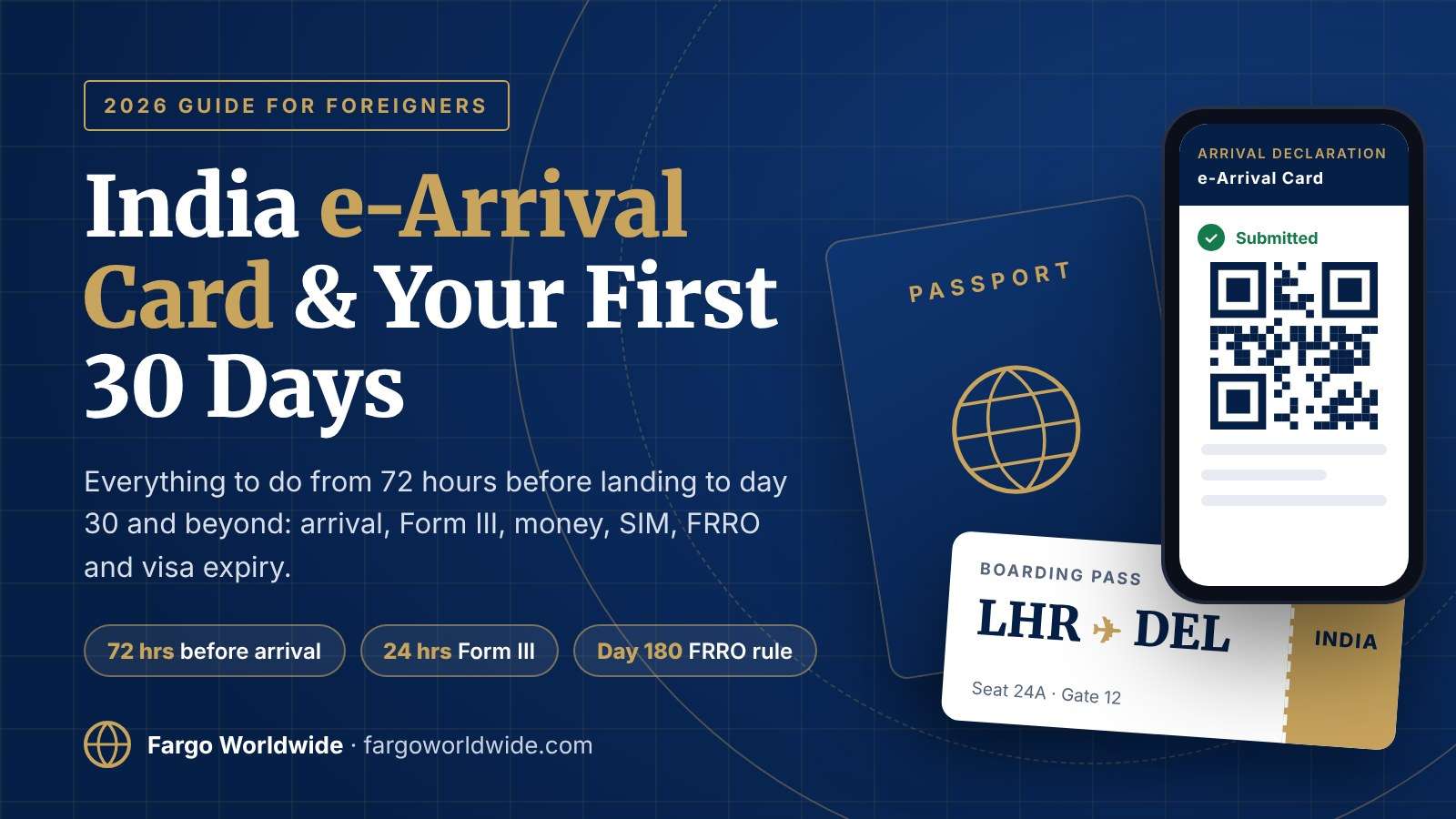
India e-Arrival Card 2026 guide for foreigners: passport, phone showing a submitted QR code and a London-to-Delhi boarding pass

E-Arrival Card Rule: Submit Online Within 72 Hours Before Your Flight

E-Arrival Card: New Immigration Rules for Foreigners Traveling to India New Immigration Rule: E-Arrival Card Required 72 Hours Before Entry E-Arrival Card Rule: Submit Online Within 72 Hours Before Your Flight The E-Arrival Card is a new immigration requirement for all foreigners traveling to India. It is mandatory for all Indian visa holders and OCI cardholders to submit their E-Arrival Card details within 72 hours before arriving in India. In this article, we will provide complete information on how to apply for and submit the E-Arrival Card online. Who Needs to Fill the online e-Arrival Card? The E-Arrival Card is issued by the Bureau of Immigration, Government of India. It serves as a digital replacement for the traditional paper disembarkation form previously filled out by travelers upon arrival in India. This requirement applies to all foreigners traveling to India, and it is mandatory for the following visa categories: Business Visa Holders Employment Visa Holders Medical Visa Holders Student Visa Holders Ayush Visa Holders Conference Visa Holders Research Visa Holders Diplomat/Official Visa Holders Tourist Visa Holders OCI Card Holders All e-Visa and regular visa holders must complete and submit the E-Arrival Card online before entering India. This helps streamline immigration procedures and save time upon arrival. What are the Details Needs to Fill in E-Arrival Card? To submit an E-Arrival Card, the applicant needs to provide basic personal and travel information. The process is simple and takes about 3 to 5 minutes to complete. Below are the details you’ll need to fill in: Personal Details Full Name (as per passport) Nationality Passport Number Purpose of Visit (Business, Employment, Medical, Student, Ayush, Conference, Research, Diplomat, Official, or Other) Arrival Details Date of Arrival in India Countries Visited in the Last 6 Days Address Details Address in India State District Contact Details Email ID Contact Number Emergency Contact Number Family Member Details (if traveling with family) For each family member: Full Name (as per passport) Nationality Passport Number Before submission, you must check the declaration box confirming the accuracy of the provided information: “I declare that the information provided above is true and accurate. I understand that providing false information may result in denial of entry or legal consequences.” Once all details are filled in, you can submit the form online and download the E-Arrival Card in PDF format for your records. Where to apply for an E-Arrival Card? The E-Arrival Card must be submitted online through official government platforms. Travelers can fill in their details using one of the following options: The Bureau of Immigration website: indianvisaonline.gov.in/earrival The Indian Visa Su-Swagatam mobile app (available on Android and iOS) After successfully submitting the E-Arrival Card, travelers are required to download and take a printout of the confirmation. This printed copy should be presented to immigration authorities upon arrival in India. Conclusion In this article, we have shared complete information about the new e-Arrival Card requirement, which came into effect on 1st October 2025. For more updates on immigration rules and guidelines, you can explore our other immigration-related articles or consult with our expert team. We have been assisting travelers to make their journeys hassle-free since 2019, and we are proud to have served over 1,000 satisfied customers worldwide.

E-Arrival Card Rule: Submit Online Within 72 Hours Before Your Flight Read More »

E-Arrival Card Rule: Submit Online Within 72 Hours Before Your Flight - Fargo Worldwide

The Complete Guide to Applying for an Indian Visa/Tourist Visa Everything You Need to Know

How To Apply For an Indian Visa For Foreign Nationals Indian Visa Process for Foreigners in India Tourist Visa is a Common visa for Traveling to India for tourism. India is an exciting and enriching experience, but navigating the Visa process of applying for an Indian Tourist Visa can be overwhelming. With the introduction of the e-visa system, the application process has become more streamlined and convenient for travellers. However, understanding the requirements, documentation, and procedures for obtaining an Indian Tourist Visa is crucial to ensure a smooth and hassle-free travel experience. This comprehensive guide will provide you with everything you need to know about applying for an  E-visa (Tourist Visa), including information on e-visas tips for a successful application. Types of E- Visa When applying for an E-visa, it’s crucial to be aware of the different types available to suit your travel purpose. The types include e-visa for short-term stays, regular visa for longer visits, and visa on arrival for certain nationalities. Each type has specific requirements and validity periods, so choosing the right one aligns with your travel plans. When applying for an E-visa, it’s crucial to be aware of the different types available to suit your travel purpose. The types include e-visa for short-term stays, regular visa for longer visits, and visa on arrival for certain nationalities. Each type has specific requirements and validity periods, so choosing the right one aligns with your travel plans. 1. E-Tourist Visa: – An E-tourist visa for traveling to India for Tourism, sightseeing, casual visits to meet friends/Family/relatives, and attending a short-term yoga program in India. One Month E-Tourist Visa for group tourist and for individual tourist with One Month (30 Days) validity. It has Double Entry, non-extendable and non-convertible Visa in India. One year E-Tourist Visa issue date form the of grant of ETA with Multiple entries. Maximum stay in India during one Calendar Year should not exceed 180 days for 1 year Tourist Visa. Five years E-Tourist Visa Issued date from the date of grant of ETA with multiple entries. Maximum stay in India during one Calendar Year should not exceed 180 days for 1 Year Tourist Visa. 2. E-Business Visa: – E-Business Visa For all activities permitted under normal Business Visa. E-Business Visa has One year (365 days) from the date of grant of ETA with multiple entries. On E-business visa Continuous stay during each visit shall not exceed 180 days. If the intension is to stay for more than 180 days, shall get registered with FRRO/FRO concerned within two weeks after the expiry of 180 days. 3. E- Medical Visa:- E- Medical Visa is for medical treatment, including treatment under Indian systems of medicine. e-Medical Visa has Sixty days (60 days) from the date of arrival in India with triple entries. You can apply for E-Medical Visa Extension with FRO/FRO as per the doctors’ recommendation in India. 4. E-Medical Attendant Visa E-Medical Attendant Visa issue to accompany someone who is going to receive medical treatment. It’s also had Sixty days (60 days) from the date of arrival into India with triple entries. 5. E-Conference Visa E-Conference Visa comes with Thirty days (30 days) from the date of arrival into India with Sigle entry. for a E-Conference visa Organizers must upload all details & documentation on the MHA website. Eligibility Requirements for Indian Tourist Visa Understanding the eligibility criteria for an Indian tourist visa is essential for a smooth application process. Factors such as the purpose of your visit, duration of stay, and previous travel history may influence your eligibility. Additionally, applicants must possess a valid Passport, provide proof of sufficient funds for the trip, and adhere to health regulations. It’s crucial to ensure you meet all eligibility requirements before starting your visa application to avoid any delays or complications. In the following section, we will discuss in detail the specific eligibility requirements for each type of Indian tourist visa. Stay informed to enhance your chances of a successful visa application. Required Documentation for Indian E- Visa Application Once you have a clear understanding of the eligibility criteria, the next step is compiling the necessary documentation for your Indian tourist visa application. Commonly required documents are a recent passport-sized photograph, a copy of your valid passport with a minimum 6 months validity, a bio-data page, proof of travel itinerary, and a confirmed return ticket. It’s important to carefully review the specific document requirements based on your visa type, whether it’s e-Tourist Visa, regular tourist visa, or medical visa. Ensuring all documents are accurate and submitted in the correct format will help streamline the application process and increase your chances of visa approval. Stay organized and thorough to set yourself up for a successful visa application experience. The Application Process for Indian Tourist Visa Applying for an Indian Tourist Visa involves a systematic process that requires attention to detail. To initiate the application, visit the official Indian visa website and complete the online application form with accurate information. The next step is Upload the necessary documents as per the requirements for your visa type And pay the visa fee through the designated online portal. If you applied a regular visa you must schedule an appointment at the nearest Indian consulate or embassy for biometric data submission and an interview if required. Familiarize yourself with the processing timelines and any additional steps specific to your case. Following these steps diligently will facilitate a smooth visa application process and enhance your chances of securing the Indian visa. Tips For A Successful Indian Visa Application Double-check all your documents and information before submitting your application to ensure accuracy. Be thorough when filling out the online application form, as any discrepancies can lead to delays or rejections. Arrange all required documents in an organized manner to streamline the application process. Keep abreast of any updates or changes in the visa application requirements to avoid any pitfalls. Prepare well for the interview, if required, by familiarizing yourself with common questions and ensuring you can

The Complete Guide to Applying for an Indian Visa/Tourist Visa Everything You Need to Know Read More »

The Complete Guide to Applying for an Indian Visa/Tourist Visa Everything You Need to Know - Fargo Worldwide

Types of Visa for Indian and Tips Everything You Need to Know

A Complete Guide on Indian Visa The government of India grants different Types of visas like E-Visa, Regular Visa, and Visa on Arrivals for Foreigners for Travel in India.  E-visa and Regular Visas are granted to a foreigner whose objective of visiting India is recreation, sightseeing, casual visits to meet friends or family, attending a short-term yoga program, medical treatment, doing work and business In India. Types of visa in India Foreign nationals can Apply for an E-Visa online over the e-Visa Portal and a Regular visa needs to be applied at the nearest Indian High Commission. E-visa processes take 2 to 3 working days and Regular Visa takes 1 to 2 weeks. Applicants can apply for E-Visa and Regular before 120 days in advance of their expected date of travel to India. There are 3 subcategories for e-Visa in India. List of Countries whose nationals are eligible for e- Visa facility Afghanistan, Albania, Andorra, Angola, Anguilla, Antigua & Barbuda, Argentina, Armenia, Aruba, Australia, Austria, Azerbaijan, Bahamas, Barbados, Belarus, Belgium, Belize, Benin, Bolivia, Bosnia & Herzegovina, Botswana, Brazil, Brunei, Bulgaria, Burundi, Canada, Cambodia, Cameroon Union Republic, Cape Verde, Cayman Island, Chile, Colombia, Comoros, Cook Islands, Costa Rica, Cote d’lvoire, Croatia, Cuba, Cyprus, Czech Republic, Denmark, Djibouti, Dominica, Dominican Republic, East Timor, Ecuador, El Salvador, Equatorial Guinea, Eritrea, Estonia, Eswatini, Fiji, Finland, France, Gabon, Gambia, Georgia, Germany, Ghana, Gibraltar, Greece, Grenada, Guatemala, Guernsey, Guinea, Guyana, Haiti, Honduras, Hungary, Iceland, Indonesia, Ireland, Isle of Man, Israel, Italy, Jamaica, Japan, Jersey, Jordan, Kazakhstan, Kenya, Kiribati, Kyrgyzstan, Laos, Latvia, Lesotho, Liberia, Liechtenstein, Lithuania, Luxembourg, Macedonia, Madagascar, Malawi, Malaysia, Mali, Malta, Marshall Islands, Mauritius, Mexico, Micronesia, Moldova, Monaco, Mongolia, Montenegro, Montserrat, Morocco, Mozambique, Myanmar, Namibia, Nauru, Netherlands, New Zealand, Nicaragua, Niger Republic, Niue Island, Norway, Oman, Palau, Palestine, Panama, Papua New Guinea, Paraguay, Peru, Philippines, Poland, Portugal Republic of Korea, Romania, Russia, Rwanda, Saint Christopher and Nevis, Saint Lucia, Saint Vincent & the Grenadines, SamoaSan Marino, Saudi Arabia, Senegal, Serbia, Seychelles, Sierra Leone, Singapore, Slovakia, Slovenia, Solomon Islands, South Africa, Spain, Sri Lanka, Suriname, Sweden, Switzerland, Taiwan, Tajikistan, Tanzania, Thailand, Togo, Tonga, Trinidad & Tobago, Turks & Caicos Island, Tuvalu, UAE, Uganda, Ukraine, United Kingdom, Uruguay, USA, Uzbekistan, Vanuatu, Vatican City-Holy See, Venezuela, Vietnam, Zambia and Zimbabwe Entry Points for Visa Holders in India Persons holding e-Visa/Regular Visa are allowed to enter India only through the designated international airports following Delhi, Mumbai, Chennai, Kolkata, Trivandrum, Bangalore, Hyderabad, Cochin, Goa, Ahmedabad, Amritsar, Gaya, Jaipur, Lucknow, Trichy, Varanasi, Calicut, Mangalore, Pune, Nagpur, Coimbatore, Bag Dogra, Guwahati, Chandigarh, and Visakhapatnam. These Are Major Types of Visa for India 1. E-Tourist Visa: – An e-tourist visa is for recreation, sightseeing, casual visits to meet friends/Family/relatives, and attending a short-term yoga program in India. There are 30 days with a single entry, 60 days with double entries, one year and 5-year visas with multiple entries in India. This is a non-convertible and non-extendable visa in India except in specific cases. 2. E-Business Visa: – E-Business Visa For all activities permitted under normal Business Visa. It has 90 days with double entries, one year and 5-year visa with multiple entries in India. This is a non-convertible and non-extendable visa in India except in specific cases (Like Married to Indian and Indian Origin). 3. E-Medical Visa: – E- medical Visa is for medical treatment, including treatment under Indian systems of medicine. E-Visas are non-extendable, but in the case of e-Medical Visa as mentioned in para 5 above.  You can apply for Visa Extension as per the doctors’ recommendation in India. 4. Business Visa (Regular Visa): – For a business visa, foreigners must follow Indian government guidelines before applying in at the Indian high commission. Foreign nationals who wish to visit India to establish an industrial/business venture or to explore possibilities to set up an industrial or business venture, other than Proprietorship Firms and Partnership Firms, in India can apply for it. Registration: – All Business Visa holders are required to register themselves with the Concern FRRO in case their stay in India on a Business Visa exceeds 180 days stay during a calendar year. 5. Employment Visa (Regular Visa): – An Employment Visa is granted to foreigners who are highly skilled and highly professional. Employment Visa is not granted to for jobs for which qualified Indians are already available in India for ordinary or secretarial/clerical jobs. Also, An Employment Visa is Not Granted to A Citizen of Pakistan Registration:  If the Employment visa is valid for a period of more than 180 days/Long Term Visa, the foreigners need to register their Employment Visa with Concern FRRO/FRO within 14 days of arrival In India. In the case of Employment Visa issued for a period of 180 days or less, Employment Visa registration is not required. 6. Entry Visa (Regular Visa): – Entry Visa (X Visa) granted to a foreigner under these conditions in India. A Person of Indian Origin, who does not hold an OCI Card, can be granted an Entry Visa (X Visa) for a period of up to five years (Long Term visa) at a time, with multiple entry. Spouse and children of an Indian citizen/Indian Origin/OCI cardholder are eligible for an Entry Visa (X-2 Visa) for a long-term visa period of up to five years at a time, with multiple entries. Who is a Person of Indian Origin? A person who held an Indian Passport. Person who or either of his/her parents or grandparents or great-grandparents, was born in, and is permanently resident in India. These are the major Types of visa for Foreigners That usually travel to India. Instead of these government provide many other visas like – Missionary Visa, Film Visa, Journalist Visa, Mountaineering Visa, Sports Visa, Conference Visa, Student and Research Visa, Project Visa, Transit Visa, E-conference Visa, E-medical Attendant Visa, E-Ayush Visa, E- Ayush Attendant Visa, And E-emergency X-misc Visa. Please read all the Instructions very carefully before applying for any Visa Process.

Types of Visa for Indian and Tips Everything You Need to Know Read More »

Types of Visa for Indian and Tips Everything You Need to Know - Fargo Worldwide
Scroll to Top