
Getting Married in India on an e-Tourist Visa: The 30 + 30 Day Timeline to Convert to X-1 Visa Without Leaving India (2026)
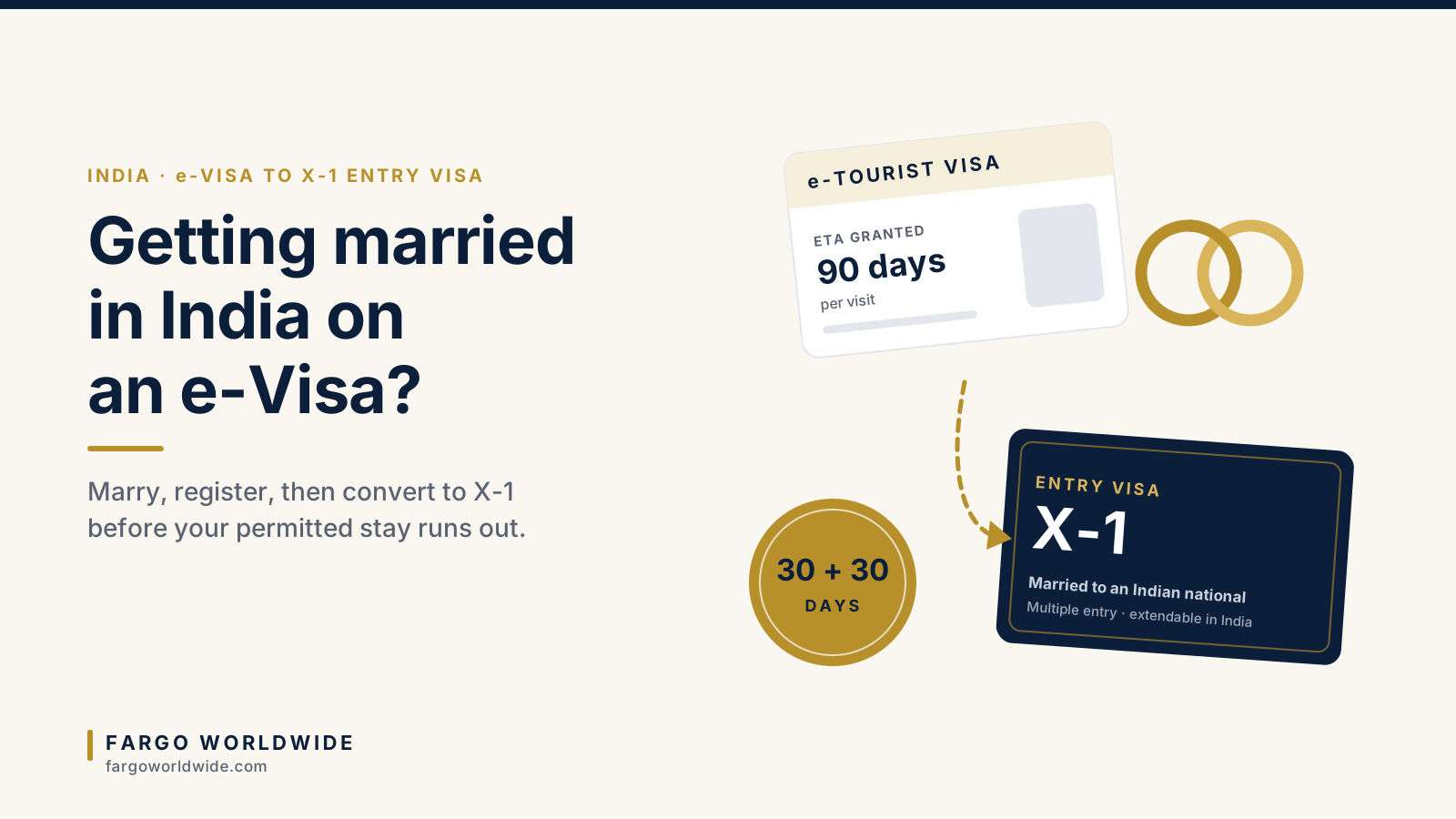
Get Married in India on e-Visa: 30+30 Day X-1 Plan (2026) Getting Married in India on an e-Tourist Visa: The 30 + 30 Day Timeline to Convert to X-1 Visa Without Leaving India (2026) By Devendra Kumar Arya, Director, Fargo Worldwide · Last verified: 31 October 2026 · 16 min read Yes, you can get married in India on e-Visa and then convert to an X-1 (Entry) visa without flying home, but only if the marriage is legally registered while your e-Visa is still valid. The catch is time. A court marriage between an Indian and a foreigner usually takes at least 30 days of residence plus a 30-day notice period, and many e-Tourist visas simply do not last that long. Most guides start after the marriage certificate is in your hand. This one starts earlier: which e-Tourist Visa to apply for, how to plan the 30 + 30 days around your stay limit, which marriage certificates the FRRO accepts, and how to file the X-1 conversion on e-FRRO before your visa runs out. If you are already married to an Indian citizen, see our guide to the X visa for spouse of an Indian citizen. Quick Answer: Can You Get Married in India on e-Visa? Yes. The e-Visa rules allow an e-Visa to be converted to an Entry (X) visa if the foreigner marries an Indian national during the validity of the e-Visa, on submission of a registered marriage certificate and a police report on the marriage. To get married in India on e-Visa safely, choose a 1-year or 5-year e-Tourist Visa (not the 30-day one), plan for 30 days of residence plus a 30-day notice under the Special Marriage Act, and file the X-1 conversion on e-FRRO before your permitted stay ends. At a glance Question Short answer Can an e-Tourist Visa be converted after marriage? Yes, to an Entry visa, if you marry an Indian national during the validity of the e-Visa. Which visa do you get? An Entry visa for spouses, now listed as X-1 in the Visa Manual (older documents call it X-2). Which e-Tourist Visa works? The 1-year or 5-year e-Tourist Visa. The 30-day e-Tourist Visa is too short for a court marriage. How long does the marriage take? Under the Special Marriage Act, usually about 60 days: 30 days’ residence, then a 30-day notice period. Which certificate does the FRRO accept? A marriage certificate issued by a state-authorised marriage registrar. Certificates from temples, mosques, churches and other organisations are not accepted. Where do you apply? On the e-FRRO portal, before your permitted stay ends. Can you work on an X-1 visa? No. Employment and business are not permitted. What comes next? Extensions in India, then OCI once your registered marriage has lasted two years. From e-Tourist Visa to X-1 Entry visa: marry, register, then convert on e-FRRO before your stay ends. What the Rules Actually Say About e-Visa to X-1 Conversion Many forum answers still say an e-Visa “can never be converted”. That is only half true. The e-Visa is non-extendable and non-convertible, with a few named exceptions, and marriage is one of them. The e-Visa rule According to the e-Visa conditions published by the Embassy of India in Mexico, an e-Visa may be converted to an Entry (X) visa if a foreigner who came to India on an e-Visa marries an Indian national during the validity of the e-Visa. The conversion depends on two things: a copy of the registered marriage certificate, and a report on the couple’s marital status, covering the foreigner’s antecedents, confirmation that the couple lives together, and security clearance. The same conditions also allow conversion to an Entry visa for a Person of Indian Origin who is otherwise entitled to one. We cover that route further below. The Visa Manual rule (clause 1.34) The Visa Manual, as reproduced by the Karnataka High Court in Raktima Khanum v. Union of India (5 January 2024), lets the FRRO convert any category of visa into an X-1 visa for a foreign national married to an Indian citizen, a Person of Indian Origin or an OCI cardholder, subject to three conditions: A registered marriage certificate. If the marriage took place abroad, the certificate must be certified or apostilled through the Indian Mission or Post concerned. Proof that your spouse is an Indian citizen, PIO or OCI cardholder, such as an Indian passport or OCI card. A report on your marital status, including antecedents, confirmation that you live together, and security clearance. The Manual adds a note that conversion will not be granted on certificates issued by temples, mosques, churches and other organisations. It also asks FRROs to run special checks for some nationalities to prevent marriages of convenience, so those files can take longer. Plan for the stricter rule. Clause 1.34 says the FRRO may convert “at any point of time”, but the e-Visa conditions say the marriage must happen during the validity of the e-Visa. Marry, register and apply while your e-Visa and permitted stay are still valid. Which e-Tourist Visa Lets You Get Married in India on e-Visa? This is where most plans fail before the couple even books a flight. India issues three kinds of e-Tourist Visa, and only two of them leave enough time for a court marriage. Only the 1-year and 5-year e-Tourist Visas leave room for the 30 + 30 days. e-Tourist Visa Stay allowed Enough for a court marriage? 30-day 30 days from first arrival, double entry, non-extendable No. A Special Marriage Act wedding usually needs about 60 days. 1-year Up to 90 days per visit; 180 days for nationals of the USA, UK, Canada and Japan Yes, with careful planning (90 days) or comfortably (180 days). 5-year Same per-visit limits as the 1-year visa Yes, on the same basis. The per-visit limits come from the Embassy of India, Muscat e-Visa page. Total stay on Tourist and e-Tourist visas also cannot exceed 180 days in a calendar year, as the Consulate General of India,