
OCI Card

Guides for Overseas Citizen of India (OCI) applicants and cardholders: the e-OCI card, passport updates, current rules and what they mean in practice. Written by Fargo Worldwide, a private immigration consultancy in Gurugram.

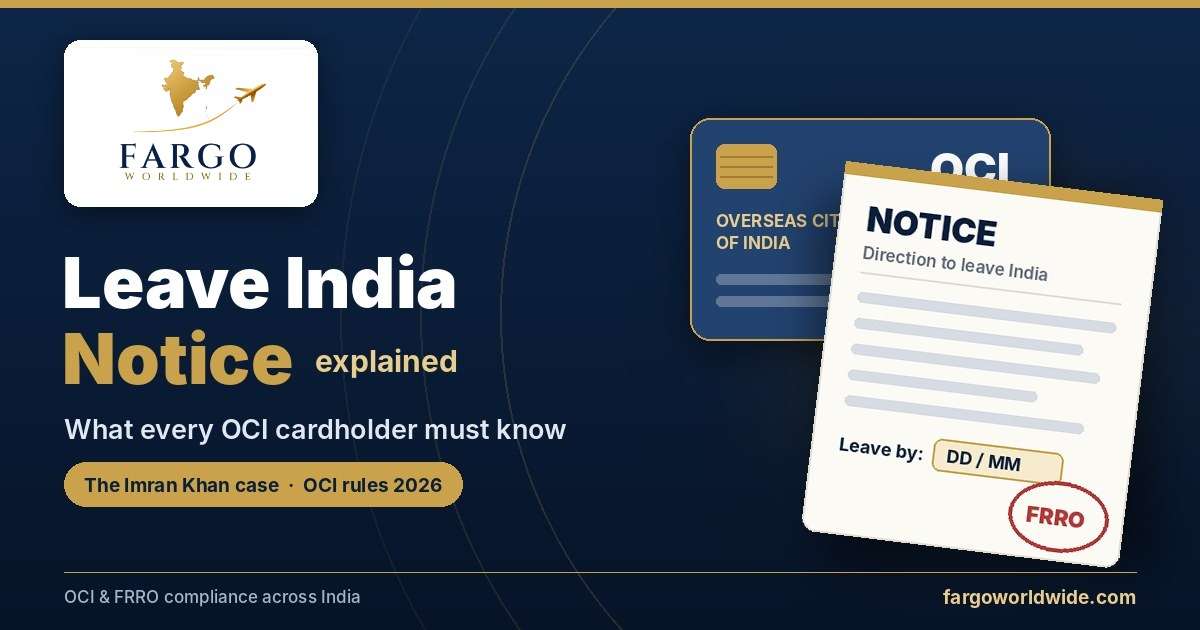
Can OCI Cardholders Join Protests in India? What the Imran Khan ‘Leave India’ Notice Means for Every OCI Holder

Can OCI Cardholders Join Protests in India? What the Imran Khan Leave India Notice Means for Every OCI Holder By Devendra Kumar, Director, Fargo Worldwide Last checked: 8 November 2026 Reading time: about 9 minutes A Leave India Notice is a written direction from the Foreigners Regional Registration Office (FRRO) telling a foreign national to leave India by a fixed date. In October 2026 the FRRO in Mumbai issued one to actor Imran Khan, a US citizen who holds an Overseas Citizen of India (OCI) card, after he attended a protest in the city. The case is still before the Bombay High Court, and it has left many OCI holders asking the same question: what am I actually allowed to do in India? This guide answers that in plain language. It covers what OCI cardholders can and cannot do, how a Leave India Notice differs from an OCI show-cause notice, the legal grounds for cancelling an OCI card, and what to do if a notice reaches you. It is based on the Citizenship Act, 1955, the Home Ministry’s March 2021 OCI notification, the Citizenship (Amendment) Rules, 2026, and the court proceedings reported so far. How we approach this case This article explains the law and the process. Fargo Worldwide takes no position on the protest, on the people involved, or on how the court should decide. Key takeaways OCI is not citizenship. It is a lifelong, visa-like status. On 2 November 2026 the Bombay High Court observed that OCI cardholders cannot claim the same rights as Indian citizens. The OCI rules list activities that need special permission, such as research, journalism and visits to protected areas. Protests are not on that list, but the government has wider powers to cancel OCI status or direct a foreign national to leave. A Leave India Notice and an OCI show-cause notice are separate steps. In the Khan case the show-cause notice gave 15 days to reply. An OCI card cannot be cancelled without a reasonable opportunity of being heard, under Section 7D of the Citizenship Act. Received a Leave India Notice? Note every deadline, reply in writing, and speak to a qualified immigration lawyer straight away. Free OCI compliance check Not sure whether something you plan to do needs permission? Tell us briefly what you plan to do in India. We’ll tell you whether a special permit or an FRRO intimation is needed before you start. Ask on WhatsApp Email us Contents What happened in the case OCI is not citizenship Can OCI holders join protests? Notice types compared Grounds for OCI cancellation Received a notice? 6 steps OCI compliance checklist What happens next FAQs How Fargo Worldwide helps 1. What happened in the Imran Khan Leave India Notice case? Imran Khan, a Bollywood actor who is a US citizen and an OCI cardholder, received a Leave India Notice from the FRRO in Mumbai after attending a protest in the city on 10 October 2026. He challenged it in the Bombay High Court, which has kept the notice on hold until the next hearing on 7 December 2026. Date What happened 10 Oct 2026 Khan attends a protest in Mumbai linked to the revision of electoral rolls and is briefly detained by police. 14 Oct 2026 FRRO Mumbai issues a Leave India Notice directing him to leave India by 28 October. Reports say it relies on the Immigration and Foreigners Act, 2025. 17 Oct 2026 He files a writ petition in the Bombay High Court. The FRRO also issues a show-cause notice asking why his OCI registration should not be cancelled, with 15 days to reply. 27 Oct 2026 The High Court keeps the notice in abeyance until 2 November. 2 Nov 2026 Khan gives an unconditional apology and a written undertaking not to join future protests. The court extends its protection until 7 December. 7 Dec 2026 Next hearing. The FRRO’s decision on his OCI status is still pending. Upcoming Timeline of the Leave India Notice case, based on court reports up to 8 November 2026 What each side argued In his petition, Khan called the notice arbitrary, unconstitutional and disproportionate. He said he has lived in India since the age of two, has no criminal record, and that no OCI rule bars taking part in a peaceful protest. At the 2 November hearing, the High Court took a different view of OCI status. It observed that an OCI cardholder cannot act as an Indian citizen or claim the same rights as one, and it asked for an unconditional apology rather than an undertaking alone. The case is Imran Khan Pal v. Union of India, Writ Petition (L) 36271 of 2026. No final ruling yet The court’s remarks so far were made at interim hearings. Treat them as a strong signal of how courts view OCI status, not as a final judgment. 2. OCI is not citizenship: what OCI cardholders can and cannot do OCI is a lifelong, multiple-entry status for foreign nationals of Indian origin and foreign spouses of Indian citizens or OCI holders. It brings many practical benefits, but in law an OCI cardholder remains a citizen of another country. OCI rights and limits under the Citizenship Act and the March 2021 MHA notification Category Details Source Can do Visit India any number of times for any purpose; stay for any length of time without FRRO registration; buy residential and commercial property (not agricultural land); practise professions such as medicine, law, architecture and chartered accountancy under the relevant law; pay the same domestic airfares and monument entry fees as Indians s.7B; MHA, 4 Mar 2021 Needs special permission first Research; missionary, Tabligh, mountaineering or journalistic work; internships or jobs with foreign diplomatic missions or foreign government bodies in India; visits to protected, restricted or prohibited areas MHA, 4 Mar 2021 Must report If you live in India, email your jurisdictional FRRO or FRO whenever your permanent address or occupation changes MHA, 4 Mar 2021 Cannot do Vote; contest elections
Can OCI Cardholders Join Protests in India? What the Imran Khan ‘Leave India’ Notice Means for Every OCI Holder Read More »

Leave India Notice explained: what every OCI cardholder must know, with OCI card and FRRO notice illustration

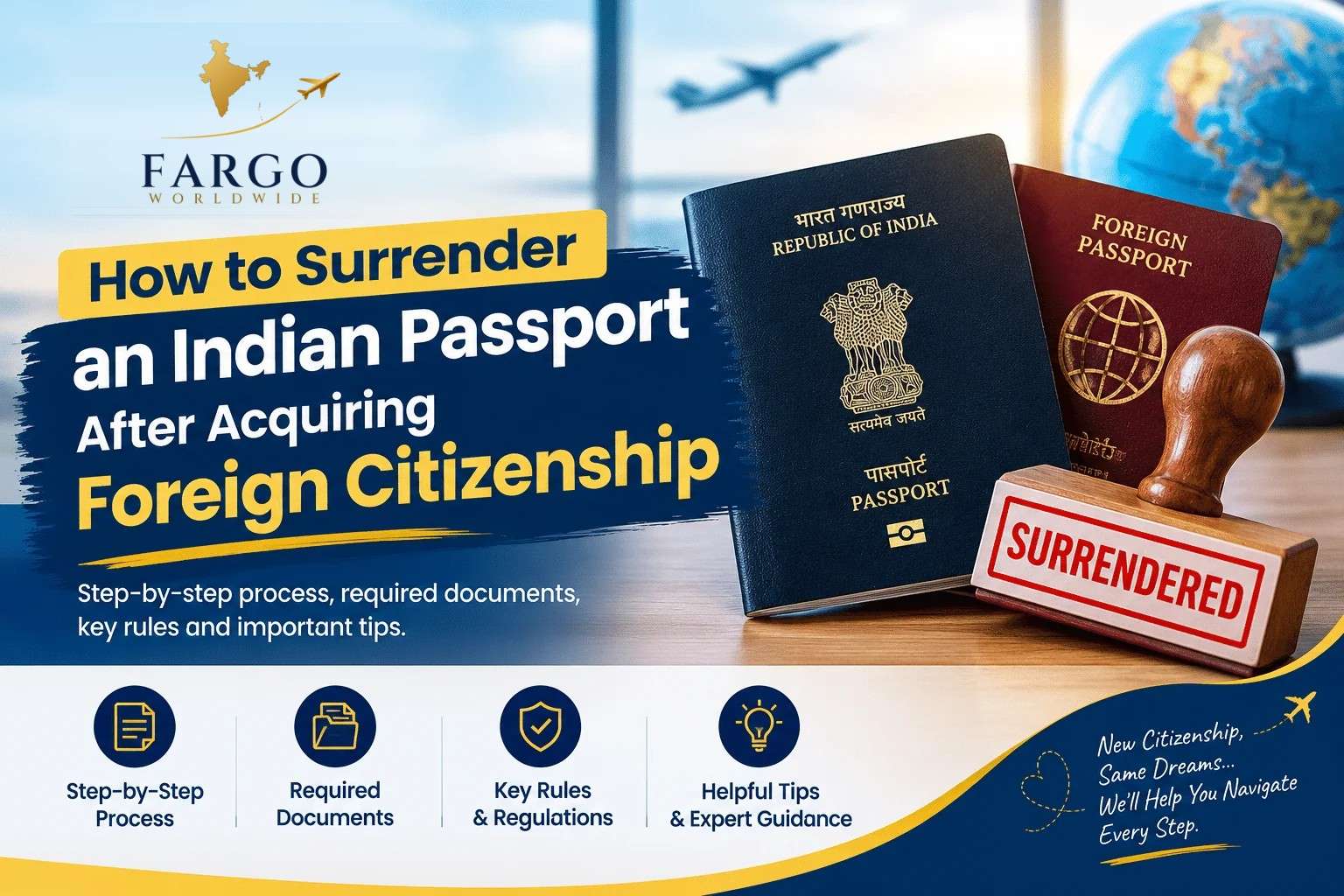
Surrender Indian Passport After Foreign Citizenship (2026)

Surrender Indian Passport After Foreign Citizenship (2026) Home › Blog › Passport & OCI Updated for 2026 · OCI & Citizenship Became a Foreign Citizen? Here’s How to Surrender Your Indian Passport the Right Way The complete 2026 guide to Indian passport surrender, surrender certificates, fees, documents and your OCI application — without the confusion, delays or penalties. By Fargo Worldwide Editorial TeamOfficial sources checked: 25 Sept 2026~22 min read Get Passport Surrender Assistance → 📞 Call +91-859-543-1267 Jump to the 12-step process Official-source basedBuilt from MEA, Passport Seva & Indian Mission pages Surrender + OCI in one placeUnderstand both processes before you apply Private consultancyFargo Worldwide is not a government authority Quick answer To surrender your Indian passport after acquiring foreign citizenship, fill in the surrender application on the Passport Seva portal for Indian Missions, then submit it with your original Indian passport, a copy of your foreign passport and your naturalisation certificate at the Indian Embassy, High Commission, Consulate or its outsourced service centre covering where you live. The Mission cancels your passport and issues a surrender (or renunciation) certificate, which you keep for your OCI application. Becoming a citizen of another country is a milestone. For former Indian citizens, though, it comes with one piece of unfinished business back home: your Indian passport. Under Indian law, an Indian citizen who voluntarily acquires the citizenship of another country ceases to be a citizen of India. Your Indian passport doesn’t stop being a physical booklet, but you are no longer entitled to hold or travel on it. It has to be formally surrendered to an Indian Mission, which gives you a certificate to prove it. That certificate matters more than most people realise. It is usually one of the documents needed for an Overseas Citizen of India (OCI) card. Without it, an OCI application can stall, and people who keep using their old passport can face penalties under the Passports Act, 1967. One more thing before we start. The process is not identical everywhere. Each Indian Mission publishes its own checklist, fee schedule, forms and service-provider arrangements. A British citizen in London and a Canadian citizen in Vancouver will follow the same law but different paperwork. This guide explains the common framework and shows you exactly what to check with your own Mission. Not sure where your case fits? Fargo Worldwide can review your passport history, citizenship dates and documents, and tell you which application route applies before you pay any government fee. Get Assistance 📞 Call +91-859-543-1267 In this guide What happens to your Indian citizenship What is a surrender certificate? Surrender vs renunciation vs OCI Who needs to surrender When to surrender Documents required 12-step surrender process Can you do it online? Fees Processing time What happens after surrender Applying for OCI Country-specific notes Minors and children Expired, lost or old passports Name mismatches 12 common mistakes Using the passport after naturalisation Travelling to India afterwards How Fargo Worldwide helps FAQs 01What Happens to Your Indian Citizenship After You Acquire Foreign Citizenship? India does not allow a person to be an Indian citizen and a citizen of another country at the same time. The key rule sits in Section 9 of the Citizenship Act, 1955: an Indian citizen who voluntarily acquires the citizenship of another country by naturalisation or registration ceases to be an Indian citizen. Several Indian Missions state this plainly. For example, the High Commission of India in Pretoria explains that for people who have acquired foreign citizenship, Indian citizenship “has already been terminated under Section 9 of the Citizenship Act 1955”, and that they need to surrender their Indian passports. Why you can’t keep using the Indian passport An Indian passport is a travel document issued to Indian citizens. Once your citizenship has ended, the passport no longer reflects your legal status, even if the expiry date printed inside is years away. Indian Missions describe holding, obtaining or travelling on an Indian passport after acquiring foreign citizenship as an offence under the Passports Act, 1967. Why the paperwork matters It closes your Indian passport record. The Mission cancels the passport and records the surrender. It gives you proof. The surrender or renunciation certificate is your evidence that you handled the change in status correctly. It unlocks OCI. Many applicants need this certificate for an OCI application. It protects future travel. Clean records reduce the risk of questions at immigration or during later applications. What about “dual citizenship”?OCI is often described as dual citizenship, but it isn’t. OCI is a lifelong immigration status for foreign citizens of Indian origin. It does not make you an Indian citizen, and it is not an Indian passport. 02What Is an Indian Passport Surrender Certificate? A surrender certificate is an official document issued by an Indian Mission (Embassy, High Commission or Consulate) confirming that a former Indian citizen has surrendered their Indian passport after acquiring foreign nationality. Depending on the Mission and the date you acquired foreign citizenship, the document may be called a Surrender Certificate or a Renunciation Certificate. Why it may be required For an OCI application. Many Missions list a copy of the renunciation or surrender certificate as a required document for applicants who were Indian citizens. As proof that you are no longer an Indian passport holder, for example when dealing with Indian authorities, banks or property matters. As evidence of your former Indian citizenship, which helps establish OCI eligibility. Surrender certificate vs OCI card These are two different documents from two different processes: The surrender certificate closes your Indian passport and records that your status has changed. The OCI card is a separate registration, applied for through the official OCI portal, that gives you a lifelong visa-type status for India. Surrendering your passport does not automatically give you an OCI card. You must apply for OCI separately, and it has its own form, fees, photographs and approval process. Keep it safeStore the original certificate with your naturalisation certificate and keep a high-quality scan

Surrender Indian Passport After Foreign Citizenship (2026) Read More »

Surrender Indian Passport | FargoWorldWide

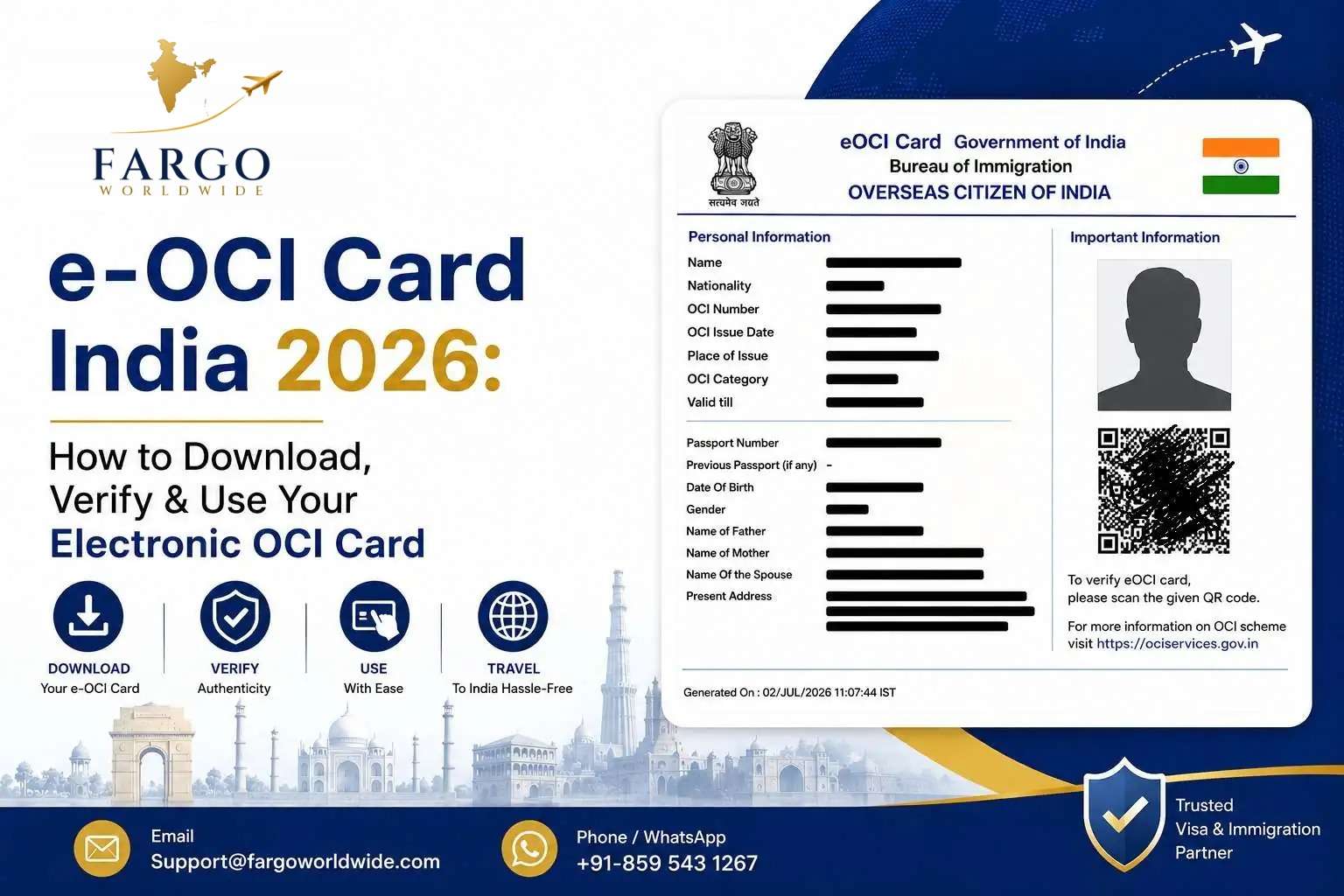
e-OCI Card India 2026: How to Download, Verify & Use Your Electronic OCI Card

e-OCI Card India 2026: Download, Verify & Apply Online | Fargo Worldwide Last Updated: 22 July 2026  |  By Devendra Kumar Arya, Director, Fargo Worldwide OCI Card Guides e-OCI Card India 2026: How to Download, Verify & Use Your Electronic OCI Card If your OCI application has been approved but the printed booklet hasn’t arrived yet, the e-OCI card is the document that lets you travel to India, prove your status, and complete FRRO or banking formalities in the meantime. This guide explains exactly what the e-OCI card is, how it differs from the physical OCI booklet, and how to download, verify, and apply for one — plus a real (identity-masked) case study of how we helped a client through the process. 1. What Is an e-OCI Card? The e-OCI card is the digital, downloadable version of the OCI Card (Overseas Citizenship of India), generated automatically once the Ministry of Home Affairs (MHA) approves an application on the OCI Services Portal. It is a PDF document carrying the applicant’s photograph, personal details, file reference number, and a scannable QR code — identical in legal weight to the laminated OCI booklet, just issued electronically and instantly rather than printed and couriered. Most applicants receive the e-OCI card weeks before the physical booklet is dispatched, which is why it has become the practical, everyday version of the document for travel and verification purposes. 2. e-OCI Card vs Printed OCI Booklet — What’s the Difference? Feature e-OCI Card Printed OCI Booklet Format Downloadable PDF Physical laminated booklet Availability Immediately after approval 4–8 weeks after approval (courier/collection) Valid for Travel Yes Yes Carries QR Code Yes Yes Needs Passport Sticker Not initially U-Visa sticker affixed to passport Long-Term Use Recommended to also obtain printed booklet Standard long-term document In practice, both documents carry equal legal standing under MHA rules, but immigration counters and some institutions still prefer to see the physical booklet with the passport sticker for long-term record-keeping — one more reason to complete both steps rather than stopping at the e-OCI stage. 3. How to Download Your e-OCI Card Go to the official OCI Services Portal Click Status Enquiry and log in with your application credentials Enter your File Reference Number and Date of Birth Once status shows “Granted” or “Printed”, the e-OCI PDF becomes available for download Save and print a copy to carry alongside your passport while travelling 4. How to Verify an e-OCI Card Is Genuine Every e-OCI card includes a QR code and file reference number. Airline staff, FRRO officers, banks, and Indian universities can verify authenticity by scanning the code or cross-checking the reference number against the applicant’s record on the OCI Services Portal. If you’re asked to confirm a document’s authenticity, always direct the request to the official portal rather than any third-party site. 5. When You’ll Need Your e-OCI Card Boarding a flight to India before the printed booklet arrives Opening an NRE/NRO bank account Applying for a PAN card as a foreign national Enrolling in an Indian university under the NRI/OCI quota Property registration or other government formalities Proving status during an FRRO interaction, if ever required Need help downloading, verifying, or applying for your e-OCI card? Fargo Worldwide has handled 3,000+ OCI cases across India and abroad. Call +91-8595-431-267 or WhatsApp us instantly. 6. Applying for a New e-OCI or Re-Issuance If you don’t yet have an OCI card, or your existing one needs re-issuance (new passport, name change, lost card), the process runs through the same OCI Services Portal, followed by document submission at your nearest FRRO or Indian Mission abroad — including postings we regularly support in Entry (X) Visa and spouse-category cases. Our complete step-by-step breakdown of documents, fees, and processing timelines is covered in our OCI Card India 2026 guide. Case Study: Helping a Client Secure Their e-OCI Card Without Delay Client: Mr. R•••• K••••, a foreign national of Indian origin based overseas Challenge: The client’s OCI application had been approved by the Ministry of Home Affairs, but with an upcoming trip to India for a family event, the printed OCI booklet was not going to arrive in time. He needed a verified, travel-ready e-OCI document and clarity on whether it would be accepted at the immigration counter. What Fargo Worldwide Did: Tracked the application status on the OCI Services Portal on the client’s behalf Retrieved and verified the e-OCI card as soon as it was generated Confirmed QR code and reference number accuracy against MHA records Briefed the client on carrying the e-OCI alongside his passport for check-in and immigration Coordinated the printed booklet’s dispatch tracking for his records after arrival Outcome: The client travelled to India on schedule using the verified e-OCI document, cleared immigration without any issue, and received the physical OCI booklet a few weeks later. What could have been a stressful, trip-jeopardising delay was resolved with zero disruption to his travel plans. Client identity has been withheld to protect privacy, in line with our confidentiality practice for all case studies. 7. Why Foreign Nationals Choose Fargo Worldwide Fargo Worldwide is a trusted immigration consultancy with experience since 2019 and a 4.6/5 client rating on Google. We handle OCI, e-OCI, FRRO registration, visa extension, and exit permit cases for clients across 25+ countries, with dedicated support for e-OCI download, verification, and re-issuance queries. See what our clients say on our testimonials page. 8. Frequently Asked Questions Is the e-OCI card enough to board a flight to India? Yes, when carried alongside your passport. Airlines and Indian immigration accept the e-OCI PDF as valid proof of status while the printed booklet is in transit. Do I still need the printed OCI booklet if I have the e-OCI? Yes — the printed booklet with the U-visa sticker remains the standard long-term document and is recommended for ongoing use, even after you’ve travelled on the e-OCI. Where do I download my e-OCI card from? Only from the official OCI Services Portal — never from a third-party website.

e-OCI Card India 2026: How to Download, Verify & Use Your Electronic OCI Card Read More »

e-OCI Card India 2026: How to Download, Verify & Use

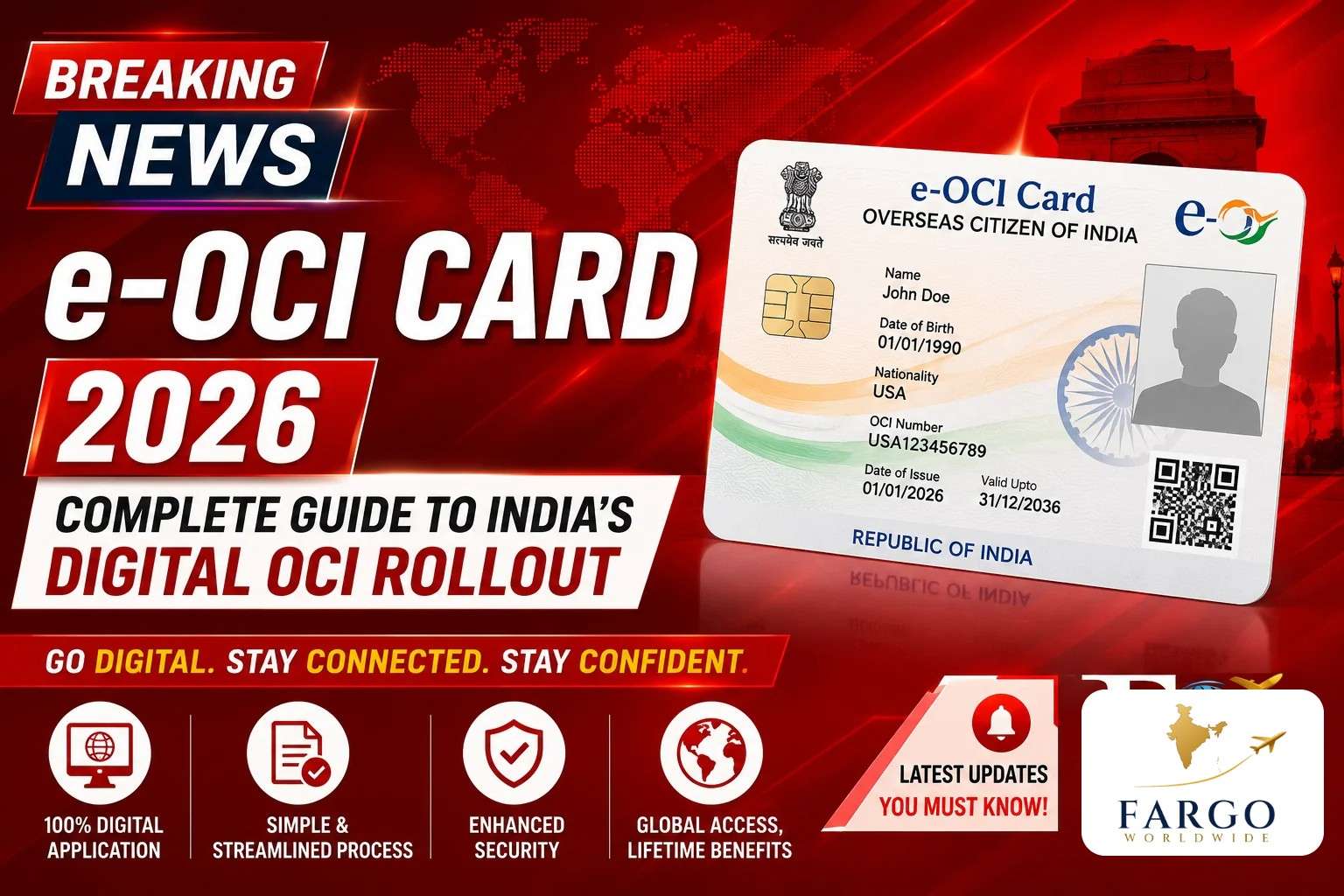
e-OCI card 2026

e-OCI Card 2026: Complete Guide to India’s Digital OCI Rollout | FargoWorldwide e-OCI Card 2026: Complete Guide to India’s Digital OCI Rollout India has digitised the entire OCI system. The physical booklet is now optional, the 6-month stay rule for in-country applicants is gone, PIO cards are dead, and there’s a new penalty for anyone who forgets to update their passport details. Here’s exactly what changed and what to do about it. Last updated: 1 July 2026 Reading time: 19 minutes Author: Devendra Kumar, Senior Immigration Consultant, Fargo Worldwide If you hold an OCI card, or you’re planning to apply for one, 2026 has been the biggest year of change to the programme since it launched in 2005. On 30 April 2026, the Ministry of Home Affairs notified the Citizenship (Amendment) Rules, 2026, and just one day before this article’s last update — on 30 June 2026 — India’s Home Minister formally launched the digital e-OCI card, capping a rollout that began on 1 May 2026. Along the way, the six-month in-country stay requirement disappeared, PIO cards were switched off entirely, and a handful of new compliance obligations quietly appeared in their place. This guide walks through what the e-OCI card actually is, who’s eligible, what’s changed in the application process, and what every existing OCI holder now needs to do differently. If you’re applying for an OCI card for the first time, or you already hold one and want to know whether anything is required of you, this is the article to read before you touch the portal. Some quick background, for anyone new to the scheme: the OCI card was introduced in 2005 as a way to give people of Indian origin who had taken up foreign citizenship a long-term, largely visa-free relationship with India, without conferring actual Indian citizenship (India does not generally recognise dual citizenship). A separate, older scheme — the PIO (Person of Indian Origin) card — ran in parallel for years, covering similar ground with slightly different documentation, before the two were merged in 2015 with PIO holders expected to convert. That merger dragged on far longer than intended, which is part of why the final decommissioning of PIO cards in 2026 has been such a significant cleanup step. The 2026 amendment is best understood as the government finally finishing that decade-old consolidation, while simultaneously moving the entire system onto a digital footing. In short: OCI applications are now fully digital and issue as an e-OCI by default, with the physical booklet optional. The 6-month continuous stay requirement for in-country applicants has been removed. PIO cards are no longer valid. OCI holders must update new passport details online within 3 months of renewal or face a USD 25 fine. Processing has dropped from roughly 6–8 weeks to about 15 business days. What This Article Covers What Changed: Inside the Citizenship (Amendment) Rules, 2026 What Is an e-OCI Card, and How Is It Different From the Booklet? Old Process vs New Process: Side-by-Side Comparison Who Is Eligible for OCI in 2026 The 6-Month Stay Rule Is Gone — What It Means for In-Country Applicants PIO Cardholders: What You Must Do Now New Rule for Minors and Dual Passports The New 90-Day Passport Update Rule (and the New Penalty) Simplified Age-Based Reissuance How to Apply for an e-OCI Card (Step-by-Step) Documents Required — Updated Checklist OCI and e-OCI Fees in 2026 e-OCI at the Airport: FTI-TTP, e-Gates & the e-Arrival Card Do e-OCI Holders Still Need FRRO Registration or Exit Permits? Renunciation and Cancellation Are Now Online Too Common Mistakes to Avoid Why Work With Fargo Worldwide for OCI & e-OCI Applications Frequently Asked Questions 1. What Changed: Inside the Citizenship (Amendment) Rules, 2026 The OCI scheme allows people of Indian origin who hold foreign citizenship — along with their spouses and children in many cases — to live, work, and travel in India without the visa restrictions that apply to other foreign nationals. It has existed since 2005, but the underlying rules had not been substantially revised in over a decade. That changed with the Citizenship (Amendment) Rules, 2026, notified by the Ministry of Home Affairs on 30 April 2026. The amendment touches nearly every part of the OCI lifecycle: Digital-first processing — applications, renunciations, and cancellations all move online through the central OCI Services Portal. The e-OCI card itself — a digital, verifiable credential that can replace the physical booklet. Eligibility changes — including broadened eligibility for Sri Lankan Tamils of Indian origin. Removal of the 6-month stay requirement for foreign nationals applying for OCI while already in India. Decommissioning of PIO cards, following a conversion deadline that closed on 31 December 2025. A new rule for minors barring simultaneous possession of an Indian and a foreign passport. A new passport-update compliance obligation, backed by a monetary penalty for non-compliance. Update: on 30 June 2026, following weeks of phased rollout, the digital e-OCI card was formally launched. New applicants now receive the e-OCI as their primary credential, and existing OCI booklet holders are expected to be migrated to the electronic format in a phased manner, typically at the point of reissuance rather than all at once. 2. What Is an e-OCI Card, and How Is It Different From the Booklet? An e-OCI card is the electronic equivalent of the physical OCI booklet — the same underlying legal status and entitlements, delivered as a secure digital credential rather than a printed document glued into your passport. It can be downloaded, stored on a mobile device, and printed as many times as needed, and it is generally described as being secured with encryption and a verifiable QR code. Practically, the differences that matter most to applicants are: No physical loss risk. A lost or damaged physical booklet historically meant a lengthy and sometimes expensive reissuance process; an e-OCI stored digitally cannot be misplaced in the same way. Faster issuance. Digital verification has cut reported processing times from roughly 6–8 weeks down to around 15 business

e-OCI card 2026 Read More »

e-OCI Card 2026 Complete Guide to India's Digital OCI Rollout - Latest OCI News and Updates
Scroll to Top